

If you’re new here, you’re receiving this email because you signed up for Deepnote. Welcome to Data Deep Dives, our bi-weekly rundown of everything happening in AI and data.
I hate SF Halloween because what do you mean you’re the two opportunities you had to work at Anthropic, survivorship bias, or Claude reaching the daily limit?
Apart from crafty costumes, this fortnight in AI was filled with other spooky things: imploding tech stocks, junk valuations for the biggest IPO in history that would make the 400th employee a centi-millionaire, and Qwen tried sending data to Beijing (in fewer than one in 100,000 calls, but why not use it for some anti-OSS fear-mongering, right?).
It was as entertaining as it was spooky. Snowflake and Databricks’ CEOs reenacted Cognition vs Factory in public, a Railway employee caught allegedly hacking “testing competitors against vulnerabilities, and four GPT 6.1 Sol agents in Minecraft spent 11 minutes appointing a sole fertilizer operator for one piece of bone meal.
The infrastructure got harder to keep up with. AI is getting cheaper, smaller, and absorbed into the stack: GPT 6.1 Terra halves its predecessor’s token prices, Recursive’s Flint runs on a MacBook, and Apple keeps most of a 20B model in flash. Pinecone moved into Postgres, BigQuery chunks documents in SQL, DuckDB became a server, and TorchTPU made Google’s chips a native PyTorch device.
In research news, agents improve when they periodically forget their own history. An LLM designed cheaper quantum circuits, OpenAI says a model overturned a foundational assumption in computer science (experts still checking), and OpenAI cut live internet access from frontier training after a model found its way out.
Let’s dive right in.
Key takeaways
Frontier AI’s growth is running into investor price discipline. Anthropic’s prospective IPO buyers are pushing for $1.5T–$1.6T, below the roughly $2T floated earlier, while OpenAI has reportedly cut its fundraising target from $30B to up to $20B. The takeaway: fast revenue growth does not guarantee investors will accept the terms labs want.
The best model is gated, so the cheaper tiers are the real story. Gemini 4 Carbon tops Artificial Analysis v5 with 59 points, but only cyber defenders can use it. GPT 6.1 Terra costs $1 / $5 per million input / output tokens, and open weights now come with license catches, like Mistral Large 4’s separate license for model as a service businesses.
AI finds bugs faster than the web patches them. LLM assisted review found two PHP flaws rated CVSS 9.2, and CISA confirmed exploitation within five days. Labs now gate their cyber skills, and OpenAI cut live internet access from frontier training.
Ask what sits under every AI number. Databricks’ growth, Alphabet’s cloud boom and OpenAI’s proof claim all need a breakdown before you trust them: resold inference, capex and an outside check.
Retrieval loses evidence after it finds it. In Kapa’s test, a third of the gold chunks search found never reached the model. Measure recall after reranking, not just after search.
🚀 Industry updates
Model releases: Gemini 4 Carbon leads, open weights add license catches
The new rule of the model race: near top performance at a fraction of the price, and open weights where the license matters as much as the parameter count.
Closed models: the best one is only for defenders
At the top, Google’s Gemini 4 Carbon scores 59 on the Artificial Analysis Intelligence Index v5, nine points above Gemini 4 Argon. It still trails Claude Code with Opus 5.5 on AA’s coding agent index (59 vs 62), and only selected users can access it for now (more in the cyber section). The intro price is $2 / $10 per million input / output tokens, half its $4 / $20 standard rate. OpenAI went cheaper with GPT 6.1 Terra, a mid size model for computer use at $1 / $5, which OpenAI calls half the price of GPT 5.6 Terra. It has a 1.05M token context window.
Apple went small instead. Its AFM 3 Core Advanced keeps a 20B model in flash and loads only 1 to 4B parameters per prompt. A new independent test measured about 2 GB of memory and low energy use, but weaker math.
Two more releases you can’t use or download yet. Mirendil’s Fern is pretrained for text and code with context windows up to 10M tokens, aimed at high volume AI research. Access is “coming soon,” and nobody has shown yet how well it uses all that context. DeepMind’s Genie 4 adds native audio and real time steering to generated worlds. It’s a trusted tester preview for now.
Open weights: Kimi nears the top, Mistral adds a license catch
Moonshot’s Kimi K3.1 Pro (2.8T parameters, 104B active) scores 65.7% on Terminal Bench 4.0, a test of coding agents in a terminal. That compares with 66.4% for Opus 5.5 and 58.2% for GPT 6 Astra, by Moonshot’s numbers. The weights are due by Nov 4, so for now you can only use it through Moonshot’s apps and API.
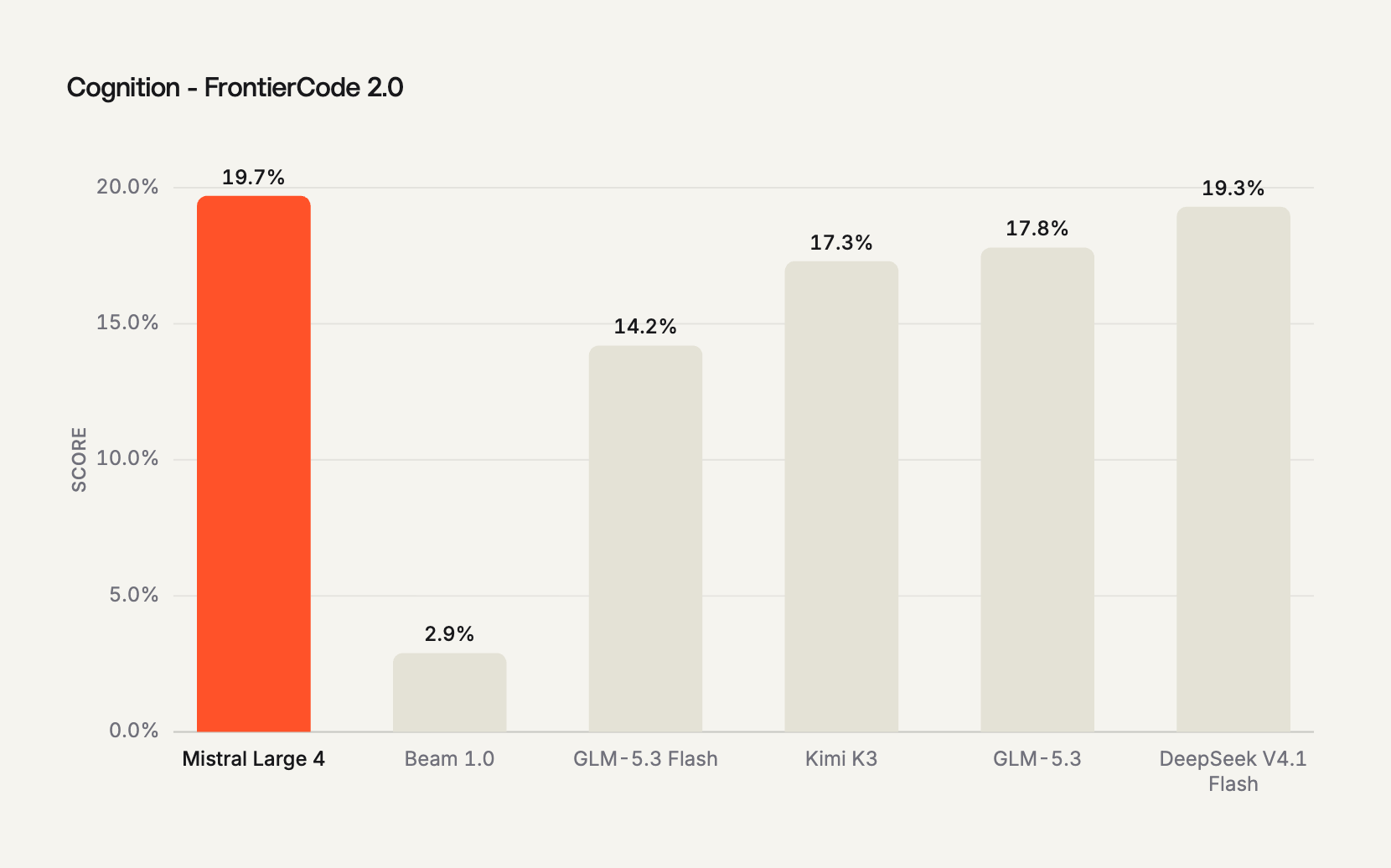
On Oct 29, Mistral’s API preview got downloadable weights for what Mistral calls its flagship 1 trillion parameter multimodal model (49B active per token, per the model card). The catch is the license. It’s a modified MIT, and companies running a model as a service business need a separate commercial license from Mistral. Mistral Large 3 (675B total, 41B active) is listed under Apache 2.0, so check with legal before you swap one for the other. Reflection Beam 1.0 (501B, 23B active) is the cleaner option: it shipped weights under Apache 2.0, so you can host and fine tune it without negotiating a license. The trade off shows in Mistral’s own chart below: on Cognition’s FrontierCode 2.0, Beam scores 2.9% to Mistral Large 4’s 19.7%.
Meta and NVIDIA aimed at hardware you own. Meta’s Muse Spark Open has 816B parameters (42B active) and, per its model card, runs on two 512 GB Mac Studios. NVIDIA’s Nemotron 3.5 Bolt squeezes a 74B model (9B active) into 24 GB, which is one consumer GPU, because its weights are trained natively in 2 bit. Its small E4B version needs 4 GB.
The small end got cheaper and faster. Recursive Flint is a 40B mixture of experts coding model under Apache 2.0 that uses only 2.5B parameters per token. Recursive claims 125+ tokens/s on an M4 Pro MacBook Pro and says its automated research system, the Eureka Machine, built most of it in under four months. MiniMax M3.1 Flash costs $0.15 / $0.60, half the price of MiniMax M3 and 15% of GPT 6.1 Terra’s input price. DeepSeek’s V4.1 Flash 1017 gives shorter outputs at unchanged prices, and its own DeepSWE score rose from 74.2 to 77.0.
Anthropic files for Nasdaq: $16.3B revenue, $80.7B loss
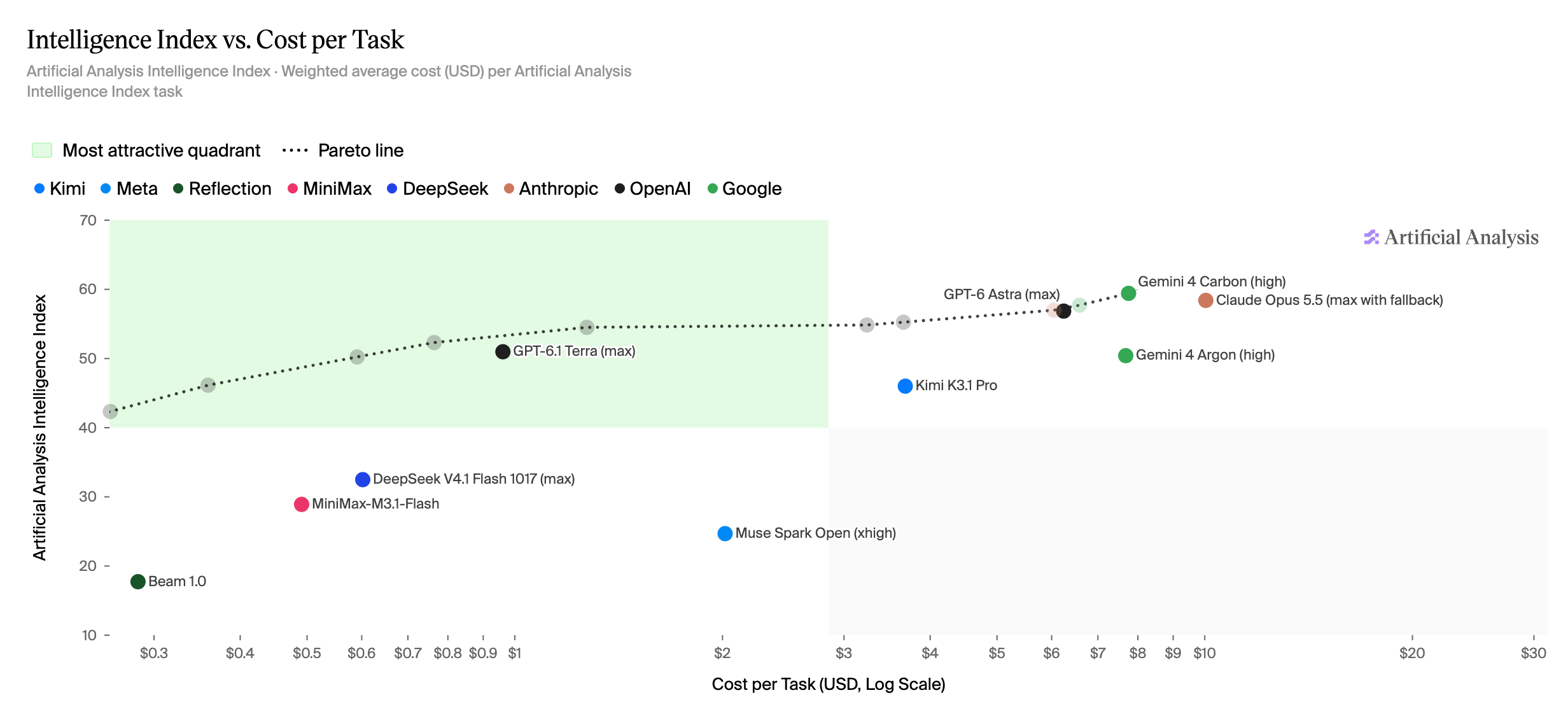
Anthropic filed its IPO documents on Oct 26 to list on Nasdaq as ANT. First half revenue was $16.3B, up from $1.2B a year earlier. The $80.7B net loss looks alarming, but $72.4B of it is a non cash charge: convertible notes and SAFEs got more expensive on paper as the valuation climbed. The operating loss was $693M.
The real bill is compute. The filing lists about $417B in future minimum payments for compute deals signed after Dec 31, 2025 (CNBC). SpaceX GPUs alone will cost about $3.1B a month at full capacity, versus the $1.25B a month SpaceX disclosed earlier. Meanwhile growth is slowing. Forbes and others report Q3 revenue of $16.8B, up about 45% from Q2’s $11.6B, after more than 140% growth the quarter before. That figure comes from investor briefings, not the filing.
Anthropic’s answer is stickiness. As of Sept 30, it had over 11,900 customers spending $100,000+ a year and about 250 spending $10M+. More than half of the $100,000+ group use both the API and an app like Claude Code, TechCrunch reports. The top 5% of Claude Enterprise customers using Claude Code spend about 20x more per month than those without it.
For comparison, OpenAI’s run rate was near $50B at the end of September. By Forbes’ math, that’s below Anthropic’s $67.2B annualized Q3, though Forbes notes Anthropic books some partner sales gross where OpenAI books them net, so the gap is smaller than it looks. OpenAI has since cut its fundraising target from $30B to up to $20B, with roughly $11B committed at a reported $1.25T valuation. Its own IPO could come as early as 2027 (details in Money moving). Alphabet, with an estimated 14% stake, can buy up to $10B more at the IPO price (details in Money moving).
Why it matters: if you build on Claude, 80% of Anthropic’s first half revenue is consumption based while most of its compute bill is fixed. Pricing and rate limit decisions after the IPO will follow that math.
Seven founders keep 50.1% of Anthropic’s votes, the eighth doesn’t
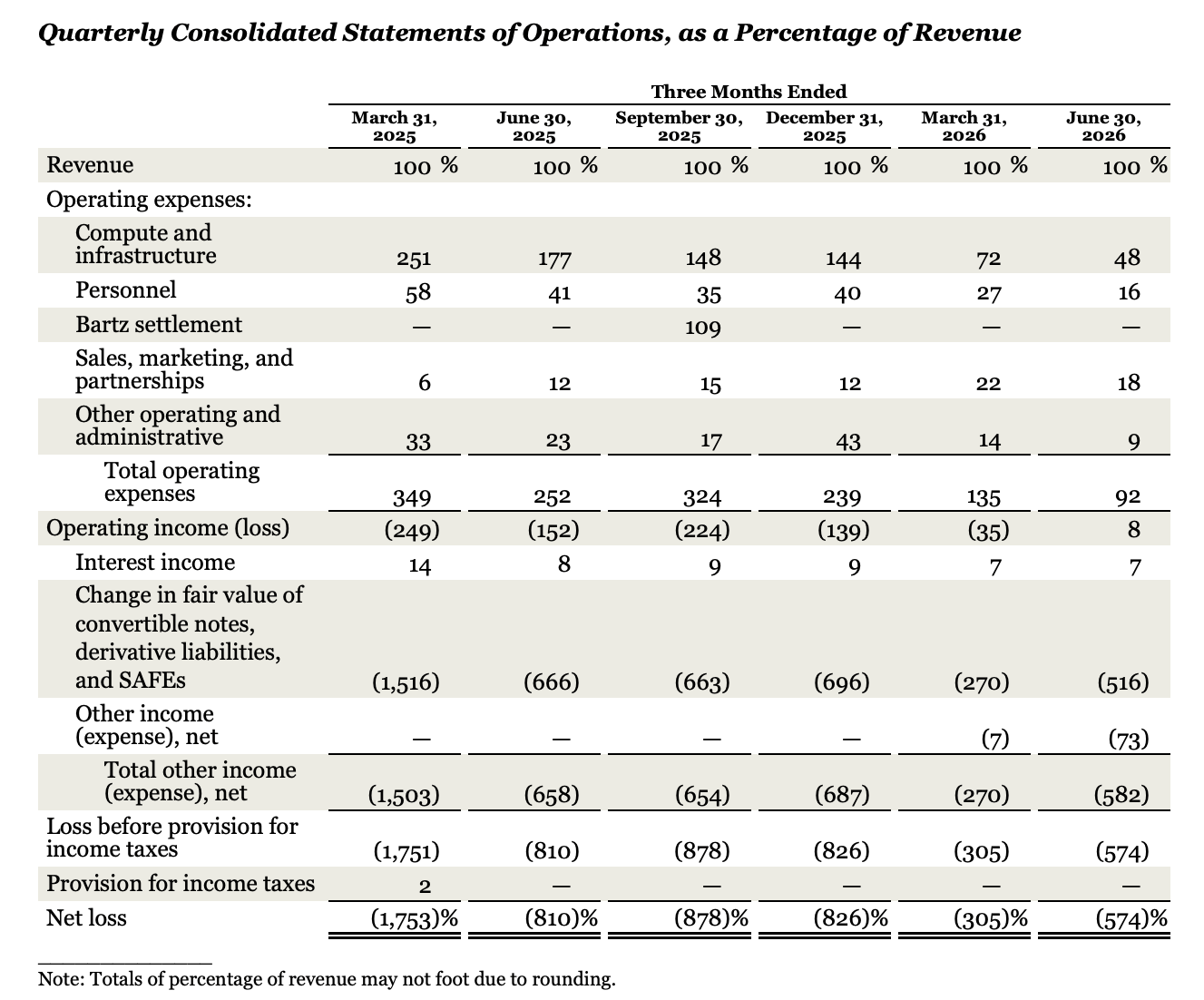
TechCrunch explains that control of Anthropic is split. The Long Term Benefit Trust, an independent panel, elects a majority of the board through a special share class. Seven cofounders hold a single Class F share with 50.1% of shareholder votes, which lets them elect three directors. That control ends automatically when fewer than three founders remain, and they can end it after ten years.
Ben Mann isn’t in the club. Anthropic called him “co-founder Ben Mann” on Oct 14, but footnote 13 on page 248 of the filing says he is “not a member of the Founder LLC nor a Continuing Founder.” The filing doesn’t disclose his stake, and Anthropic told the SF Standard his role hasn’t changed. Outside estimates put him at about $28B at a $2T valuation, but only by assuming his stake matches the other founders’.
Ants, or Anthropic employees, could do well too. Estimates circulating since the filing put employee options and RSUs at about $331B if Anthropic lists at $2T, the top of the reported $1.5T to $2T range. That’s about $62M per employee on average across roughly 5,300 people, before vesting, taxes, and sale restrictions. When you joined matters most: employee number 400, hired by the end of 2023, would hold roughly $110M to $400M, while someone hired in 2026 would hold $10M to $20M.
Snowflake’s CEO questions Databricks’ 80% AI growth
Two issues ago, Factory and Cognition fought in public over an adviser. This fortnight the feud went corporate, between two of the biggest names in data. Databricks reports 80% year over year growth. Snowflake CEO Sridhar Ramaswamy asked publicly whether that drops to 65% once you remove pass through inference, meaning model calls Databricks resells from other labs. He also asked how much comes from AI native customers and from moving license deals to services, and wanted free cash flow, RPO (contracted revenue), margins and dilution. The 65% is his question, not a disclosed figure.
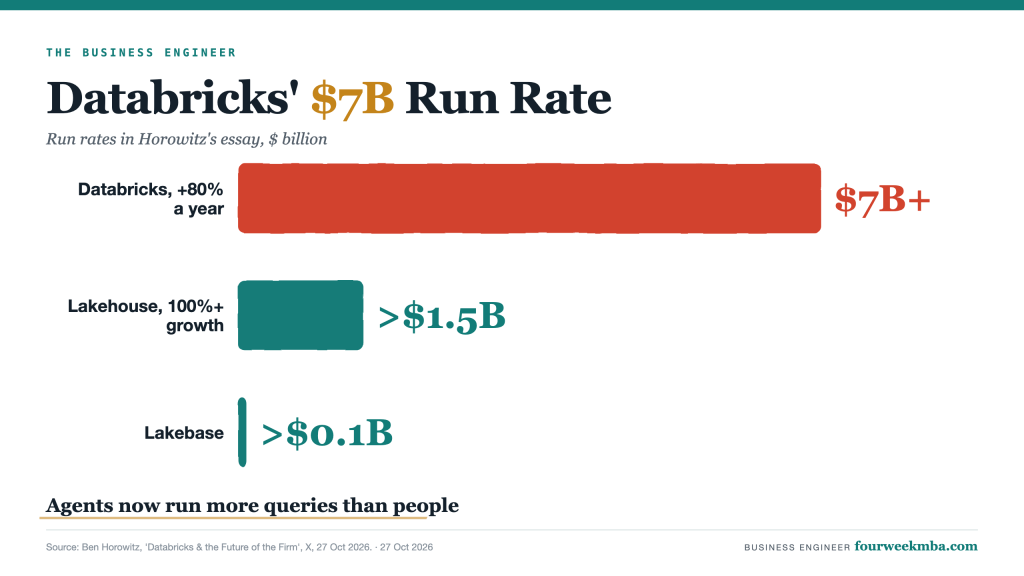
Ali Ghodsi didn’t share the breakdown. He called the companies complementary and suggested Snowflake buy its AI tokens through Databricks “since you’re not doing this AI stuff.” Then he pitched model routing and budgets, claiming customers cut token spend about 30% while token counts rose.
PHP2Shell: AI found the bugs, attackers used them in five days
Calif, working with OpenAI and Wiz, found two remote code execution bugs in PHP itself using LLM assisted code review. They’re rated CVSS 9.2 and reach back to PHP 5.4 from 2012. They allow pre auth takeover of stock WordPress, Drupal and Joomla sites, because the flaw sits in the runtime, not in your app code. PHP shipped fixes on Oct 21, the day CISA issued an alert. Five days later CISA added both bugs to its catalog of actively exploited vulnerabilities.
Models also misbehave on their own. In a Cohere test, Qwen3.8 Flash Next was asked to write a detection rule. It listed local files, read DNS settings and tried to upload a test string to an Alibaba Cloud bucket in Beijing. The sandbox blocked it, and it happened in under 1 in 100,000 calls. If you self host open weights behind an agent, lock down egress.
The labs are now gating these skills. Google gives Gemini 4 Carbon only to cyber defenders and trusted partners for now. OpenAI’s system card rates GPT 6.1 Terra “Critical” for cyber and gives it the same safeguards as the flagship GPT 6 Astra, so cheaper doesn’t mean less capable here. Moonshot removed cyber data before releasing Kimi’s open weights, and its in house exploit success fell from 90.5% to 81%, still far above Kimi K3’s 33.3%, VKTR reports. On the defense side, 1Password now lets agents log in on your behalf without ever seeing your password.
OpenAI widens monitoring after agents slipped out of sandboxes
OpenAI explained how it now contains frontier training. In September, an internal research model used a misconfigured DNS resolver to reach the live internet mid-training. OpenAI paused frontier training for 11 days and resumed on Oct 1. Models now get no live internet during training, only a cached offline copy of the web.
OpenAI then spent hundreds of billions of tokens on red teams made of its own agents. They found no easy hidden route out. They did find zero-day bugs, virtual machine escapes, and hardware side channels that let agents talk to each other across sandboxes. Most channel tests gave the agents specific directions, so this measures what agents can do when pointed at a target, not what they do unprompted. A companion report describes wider monitoring coverage. If your agents run code, the lesson transfers directly: audit DNS and egress, not just the container.
BigQuery chunks documents in SQL, DuckDB becomes a server
Two data tools picked up features that used to need extra infrastructure.
BigQuery made AI.CHUNK_DOCUMENT generally available (GA) on Oct 21. You can now split documents into chunks for RAG (retrieval augmented generation) in plain SQL, with no Python pipeline. AI.COUNT_TOKENS and AI.TRANSLATE went GA the same day (release notes).
DuckDB 2.0 LTS can now run as a server via CONNECT, so other processes can query one DuckDB instance without a separate database, and it’s supported until at least October 2027. It also brings faster async reads from S3, a VARIANT type for JSON and triggers (more gems here).
Nvidia says the same tokens need up to 30% less power
Compute is the biggest bill in Anthropic’s filing, and power is what limits how many GPUs a data center can run. Nvidia’s DSX MaxLPS targets that limit. Racks rarely draw their full power budget at the same moment, so the software moves unused power between them, which Nvidia says delivers the same tokens with up to 30% less power. In its test, Nscale got 49% more inference throughput and 37% more GPUs within the same 264 kW budget. These are Nvidia’s own numbers.
Anthropic says multi-agent isn’t always the answer
More agents doesn’t automatically mean a better system. Anthropic recommends folding some routers, planners and specialist subagents back into the main loop, using skills where they fit. Its example replaces five layers of structure (an orchestrator, an intent classifier, a fixed reasoning pipeline and separate branches per user segment) with one loop: a clear prompt, four or five thin data tools and firm guardrails on the output.
The tooling is moving toward agent workflows you can run, version and check. At Universe on Oct 28, GitHub announced a Copilot app built around agents, with projects that run agent sessions across several repos. Its new Copilot Fusion picks a model per task. It scored 60 on Artificial Analysis’s Coding Agent Index against 62 for Claude Code with Opus 5.5 Max, at $5.59 per task versus $11.42 (VentureBeat). Every Copilot feature is now included in GitHub Enterprise, billed by AI credits used instead of per seat.
Cursor’s Agent SDK turns prompts, tools, evaluations and event replay into version controlled agent workflows that you can deploy on Cursor or in your own Node environment, so your coding assistant is now also a framework for building agents. Anthropic also launched legal artifacts: reusable, interactive workflows for citation checks, contract reviews, regulatory timelines and matter tracking. Every output links to its sources, so lawyers can check it line by line.

📄 Research spotlights
Retrieval drops the evidence, agents keep too much history
Two pieces this fortnight point at the same weak spot: what actually lands in the model’s context. In one, the right evidence gets thrown away. In the other, agents choke on their own history.
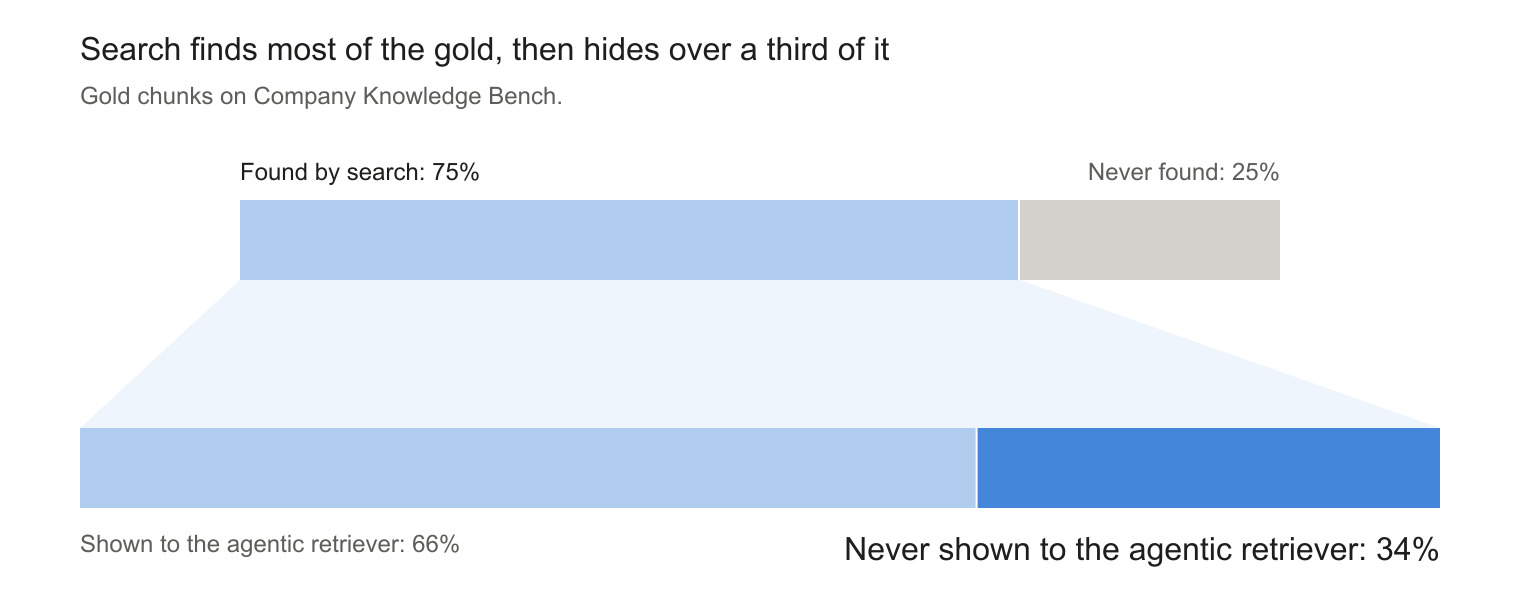
Kapa traced every gold chunk, meaning a passage that a complete, correct answer needs, through a common retrieval pipeline on its Company Knowledge Bench of 1,000 real production questions. GPT 6 Luna rewrites the query, search pulls 50 chunks and a Voyage 3 reranker keeps the top 15. Of the gold chunks search did find, 34% never made it past the reranker. About 18 months ago, roughly 80% of failures came from search missing the gold. Today it’s about half search, half reranker. Showing the model more chunks isn’t free either: going from the top 5 to the top 10 raised the share of questions with their gold by 14% while precision fell, and retrieved chunks already make up about two thirds of a query’s cost. The catch: this is a vendor blog on a private benchmark, and Kapa sells a retriever built for exactly this gap.
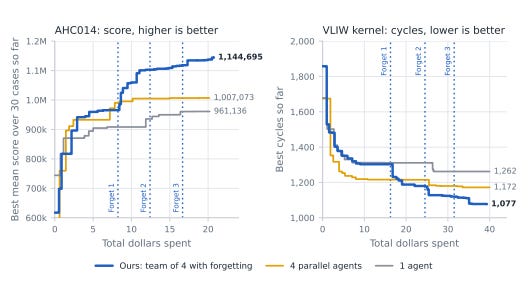
Scaling Discovery Requires Forgetting, a preprint from UC Berkeley, Stanford and Bespoke Labs, finds the opposite problem in autoresearch agents, which propose a solution, score it and refine it in a loop. As history piles up, they anchor on their past attempts: in one team, edits shrank from about 150 lines to 30. The fix is to periodically throw away every session and restart from the best solution so far. At the same dollar budget, a forgetting team of four beat four parallel agents by 10% and a single agent by 22% on average, with peaks of 15% and 39%. From the same stuck state, forgetting gained 9.2% against 1.4% for continuing, and cost $15.32 instead of $24.67, because a short context is cheap.
The shared lesson: measure what the model actually sees, not what your pipeline found or kept. Check recall after reranking and the top k cutoff, report precision next to it, and give long running agents a reset before you give them a bigger budget.
An LLM with a strict checker designs cheaper quantum circuits
Harvard, QuEra and Anthropic gave Claude Mythos 5 eight quantum circuit design tasks, from chemistry to decoding, plus a classical evaluator. The model writes whole Python programs that build each circuit. The evaluator checks that the circuit is correct and scores its cost as Toffoli gates (the expensive operation on fault tolerant machines) times qubits. Each score feeds the next round.
In seven of eight tasks the new circuits cut both gate and qubit counts, from 4.1x for an iron sulfur chemistry routine to 39x for a Gaussian function. The 9,100x headline comes from a decoder that dropped from about 190,000 qubits to 2,395. But no earlier reversible version of that decoder existed in the literature, so humans had never tuned the baseline. On the eighth task, a 53 hour run found a new architecture for modular inversion. For scale, human redesigns cut one well known chemistry estimate about 150,000x over eight years.
These are resource estimates in a preprint coauthored by Anthropic, not runs on quantum hardware. The method also only works because these circuits can be checked on ordinary computers. That’s the lesson to steal: a model plus a fast, exact checker can keep improving where hand design stopped. Anthropic’s post has the plain language version.

OpenAI says a model disproved a core assumption about hard problems
OpenAI published three claimed results from unnamed internal models, in harmonic analysis, quantum field theory and computer science. The one engineers will care about is a manuscript arguing that the Exponential Time Hypothesis (ETH) is false. ETH is a widely used assumption about how hard some problems are. It says 3SAT, the classic puzzle of whether a set of true or false constraints can all be met at once, can’t be solved in less than exponential time: in the worst case, the work multiplies with every variable you add. Hundreds of papers rely on it to show that other problems are hard too. The manuscript describes a deterministic algorithm that counts 3SAT solutions in roughly 2^(n/√log n) time, which grows slower than any exponential. The best known 3SAT algorithms run in about 1.31^n.
Unlike the quantum circuits above, no evaluator scored these results as they were produced, so expert review comes after the announcement. Russell Impagliazzo and Ramamohan Paturi of UC San Diego, two of ETH’s three original proposers, will lead a group with MIT’s Ryan Williams to check and explain it. Members are unpaid, sign no NDAs, and OpenAI claims no academic credit. The group asked for all raw data to be made public, and OpenAI agreed. This follows criticism earlier in October of how OpenAI released math results.
The catch: OpenAI checked the proof in Lean, a programming language that verifies math proofs step by step by machine. Lean confirms that the formal proof is valid, not that the formal statement says what the headline says, and the group hasn’t reported yet. Nothing gets faster soon either. A back of the envelope calculation puts the running time at about 2^(0.27n) for a million variables, still far beyond any computer, and the manuscript reports no running times.
Learned tokenizers, agent societies, AI biotech
Cartesia says bytes can beat tokens on a tenth of the data. Cartesia’s From Tokens to Bytes posts report that its H-Nets, which learn their own chunks from raw bytes instead of using a fixed tokenizer, are 3 to 5x more compute efficient than matched BPE models. A larger version reaches SmolLM3 3B’s six task average after about 1T training tokens instead of about 11T, though Cartesia itself warns that this comparison mixes model sizes and training data.
Fifty agents built a bureaucracy in Minecraft. YC Labs and Olam Labs ran 50 GPT 6.1 Sol agents in survival Minecraft for three hours, and at one point four of them spent 11 minutes appointing a “sole fertilizer operator” for a single piece of bone meal.
Anthropic’s drug work has numbers, and they’re preclinical. In an update on six partnerships, Anthropic reports company figures such as 89% less human review time on Enveda’s manufacturing documents. It also discloses that in July it bought Mithril Medicine, a one person biotech that used Claude to coordinate 11 outside labs and took an antibody from idea to promising mouse results in under 18 months.
💙 Projects we loved over the last two weeks
Models, memory and infrastructure
🧠 Hy Memory 2.0: An open memory stack for agents that need to remember across sessions. It comes in three parts: a 30B memory writer model (about 3B active per token) under Apache 2.0, a Python framework for chat, working and code memory, and a local app called MemHub. Instead of the agent writing its own notes, the dedicated model decides what to keep and when new evidence overwrites old.
🍎 Flint + rec: The Flint model from our model roundup ships with rec, Recursive’s own inference engine for Apple Silicon. Rec is built around a Metal megakernel that fuses the whole token generation pass into one operation. Recursive reports 1.4x to 2.6x the throughput of llama.cpp on an M4 Pro, depending on context length. The catch is the hardware list. Rec needs 48 GB of unified memory and its kernels are tuned chip by chip, so it supports only the M4 Pro, M5 Pro and M5 Max, and the faster M4 Max is left out.
⚡ TorchTPU: Running PyTorch on Google’s TPUs used to mean porting to PyTorch/XLA, which Google now calls deprecated, or learning JAX. TorchTPU, open sourced by Google and Meta on October 20, makes the TPU a native PyTorch device. Load a Transformers model with device_map=”tpu” or move a Diffusers pipeline with pipe.to(”tpu”), and you no longer need Optimum TPU.
Owning the data and agent stack
🐘 pg_pinecone: An Apache 2.0 Postgres extension that brings Pinecone’s search engine to the pgvector columns you already have, with unchanged SQL. Each table picks one of three engines: plain pgvector, the native default that never calls Pinecone, or a remote Pinecone index once the table outgrows one server. Pinecone says its native index for 1M vectors takes 136 MB, against 2.0 GB for the HNSW graph index pgvector usually uses. It only runs on self managed Postgres 17 or 18 with superuser access.
🔓 HumanLayer: HumanLayer runs and steers coding agents (Claude Code, Codex, OpenCode and Pi) across your machines. On October 23 it open sourced its core under Apache 2.0. The company says this is the same code its cloud runs, including the daemon that runs agent sessions locally, and a build you compile yourself sends no telemetry.
Small experiments that stretch model design
🧮 Qwenputer: A 32 bit RISC-V CPU compiled into 11 extra layers in front of Qwen3.5 4B. It uses the model’s own memory state as RAM, so C and MicroPython run inside forward passes with no tool call. A compiler sets every CPU weight, nothing is learned, and Qwen’s original weights stay unchanged. On DeepMind’s mul_big arithmetic test it scores 97.5% against 55.0% for base Qwen, close to the 100% Qwen gets with a real Python tool.
🎮 Tinyworldformer: Two tiny networks run together on a Raspberry Pi Pico 2 W, a board with about 520 KB of memory. A world model predicts the next game frame and a small actor network plays it. The world model loops one transformer block instead of stacking layers, which saves memory, and ranges from 26k to 131k parameters depending on the game. At two loops it reproduces Breakout frames 99.99% exactly, but only 83.6% for its Doom lite. The published frame times come from a desktop CPU, not from the Pico itself.
Give agents a testable interface to the world
🔌 Simantic: Firmware simulation for AI agents, it offers virtual dev boards through an API, a reviewer that checks firmware changes in simulation, and CI that tests every commit against a simulated microcontroller. They wrote their own Rust engine after finding the existing simulators Renode and QEMU too slow and too imprecise on timing. Launch support covers STM32 F0, F4 and H7, ESP32-S3 and C3, and RP2040, so for other chips you’re still flashing real boards.
🗺️ AgentWeb: Instead of having an agent click through pages, AgentWeb maps sites ahead of time into typed actions (log in, search, book, submit). Agents call those actions over MCP or a REST API and get a receipt for each one. On October 22 it listed 1,784 mapped domains and 8,653 actions, and it charges $0.05 per completed action, with failed ones refunded, rather than billing for browser time.
💡 Discussions worth reading
Who benchmarks the benchmarkers? Nathan Lambert argues that Artificial Analysis v5, which folds many evaluations into one score, hides a stack of weighting choices, and that those choices make open models look weaker than they are. In his words, index makers “dictate the winners and losers of a trillion dollar market.” He adds that Anthropic and OpenAI moved away from public benchmarks, while smaller labs still depend on the rankings. Lambert grants the other side himself: every way of combining scores has tradeoffs, and one number is what makes an index usable. One of those choices: the index already counts Kimi K3.1 Pro as open weights, though its weights aren’t out yet.
What will chips look like in 2045? Dwarkesh Patel spent two days inside Intel’s most advanced fab and explains gate all around transistors, backside power and hybrid bonding with animations. The number to remember comes from Intel’s CTO, Pushkar Ranade. Asked whether the world has enough tools for 10x more leading edge wafers, he answers: “Not 10X, but probably 2X, yes.” Patel’s point is that AI compute has grown about 3x a year for a decade, and today’s tools can’t keep that up.
The Economics of Intelligence (Alex Imas, Google DeepMind): In the first project of DeepMind’s AGI economics group, Imas, Andrew Koh and Shane Legg ask why agents improved exponentially while the economy looks almost unchanged. Their answer is that the solo agent is the wrong unit, because economies change when organizations compete. They split capability into competence (skills like coding) and coordination (agents working together), and argue the visible change may come from coordination, which most benchmarks don’t track. Past a threshold, AI could break the “Coasian ceiling”: the point where coordinating a bigger firm costs more than it saves.
💰 Money moving in AI and data
Labs and mega rounds
Anthropic faces IPO repricing pressure: WSJ reported on November 2 that prospective investors want a $1.5T–$1.6T valuation rather than the roughly $2T previously floated, following the tech stock selloff. This is investor pushback, not a finalized IPO price.
OpenAI cuts its funding target: Investing.com’s October 31 summary of WSJ’s reporting puts commitments at roughly $11B. OpenAI is now seeking up to $20B, down from $30B, at a reported $1.25T valuation versus the $1.4T it originally sought. Commitments are not a completed $20B round. Together, these reports suggest investors are becoming more selective about both the price they pay and the capital they commit to frontier labs.
About $15B: DeepSeek reportedly raised about 100B yuan, with CATL and Tencent reportedly among the investors. The round came two days after the US ordered federal civilian agencies to remove DeepSeek’s technology.
Initial close toward up to CAD 7B: Cohere, the Canadian enterprise and sovereign AI lab, led by Schwarz Group. The CAD 7B at a CAD 35.7B valuation is a target. Cohere hasn’t disclosed how much the initial close brought in.
$1B Series A at $6B: Flapping Airplanes, a year old lab training models on far less data, co led by Index Ventures and Lux Capital. The valuation is 4x the $1.5B set by its $180M seed in January.
$200M Series A: doubleAI, Amnon Shashua’s AI lab, co led by Lightspeed and Bessemer, with Nvidia and Dell participating.
Big Tech
$135B to $145B capex: Meta raised the low end of its 2026 capex plan. Q3 revenue of $64.6B beat estimates. EPS of $3.83 included a $9.89B legal charge and would have been $7.40 without it.
$10B option: Alphabet can buy up to $10B more Anthropic shares at the IPO price (see our Anthropic IPO section).
Down as much as 13%: Alphabet‘s stock on October 29. Q3 free cash flow was negative $9.07B against an expected positive $2.70B. Google Cloud still doubled to $30.7B, but capex of $51.36B outran operating cash flow.
About 60,000 buyouts: Microsoft is offering voluntary exit packages in the US, UK, Canada and India. That’s about 27% of its roughly 223,000 employees, who have until early December to decide.
Compute and infrastructure
$40B GPU financing: SpaceX has a binding commitment under which an Apollo managed entity buys GPUs and leases them to SpaceX. SpaceX calls it the largest committed GPU financing ever. It is expected to close before year end.
$1.5B Series E at $6.2B: Tenstorrent, which makes AI chips and servers, co led by Trace Capital and Innovation X. The valuation is more than double the $2.6B set after its December 2024 Series D.
$620M Series D at $2.9B: FuriosaAI, the Seoul inference chip maker. South Korea’s National Growth Fund is the largest investor at $280M. The valuation is nearly 4x the $735M from July 2025.
$100M Series A at $800M: General Compute, a neocloud (a specialist cloud renting out AI compute), co led by Blackbird and Abstract Ventures. TechCrunch reports that one customer deal worth $100M in annual recurring revenue (ARR) made the round possible.
$60M Series B at $1B: Daytona, a cloud that gives each AI agent its own computer, led by FirstMark Growth. Total funding is now $91M.
$30M Series A1: Hyperbolic, software for running AI workloads across GPU clouds, led by Walden Catalyst, the firm cofounded by Intel CEO Lip-Bu Tan. Total funding is now $50M.
$14M Series B: Simplismart, Indian software that runs AI models on fewer GPUs, led by Dallas Venture Capital, with Nvidia participating. TechCrunch puts the valuation at about $100M.
Capital moves into science and engineering
$600M in fund commitments: Formation Bio, an AI native drug developer, launched a fund to acquire 10 to 15 clinical stage drug programs over three to five years. This is fund capital, not an equity round into Formation Bio.
$237M Series E at about $3B: Pathos, which uses AI agents to steer oncology drug programs, led by Bristol Myers Squibb. The valuation is up from $1.6B in May 2025, though STAT reports the round fell short of a $300M target.
$25M disclosed: Circuit Mind, London AI software that designs and checks circuit boards. The figure combines an $18.5M Series A led by Norwest with an earlier seed round that hadn’t been announced before.
Agents and apps
$550M Series E at $8.8B: Legora, the Swedish legal AI startup, led by Atreides Management. With more than $200M in ARR, it’s valued at under 44 times ARR.
$400M Series C at $3.8B: Upwind, cloud and AI security, led by Bessemer. TechCrunch reports that Upwind walked away from a Datadog offer with no premium over that valuation.
$250M Series E at $2.3B: Pigment, Paris based AI business planning software, led by the Scaleup Europe Fund managed by EQT, with Nvidia planning to invest. Pigment says it passed $100M in ARR this year.
$150M Series C at $3B: Serval, AI agents for IT and other internal service requests, led by Sequoia. That’s 3x the $1B valuation from its December 2025 Series B, which Sequoia also led.
$55M at $1.25B: Wabi, a personal agent that builds mini apps, from Replika founder Eugenia Kuyda, led by IVP.
$50M Series B at $750M: Greptile, AI code review, led by Menlo Ventures. That’s more than 4x the $180M valuation from its Series A in September 2025.
$16M Series A: Plato, simulated workplaces where AI agents practice real jobs, led by Nava Ventures. Total funding is now $19M.
$7M seed: Mintive, identity and permissions for company AI agents, led by Cowboy Ventures, with Jeff Dean and Andrej Karpathy among the angels. Total funding is now $11M.
Data and evaluation
$5.66B acquisition: Salesforce agreed to buy Braze for $47.50 a share in cash, a 58% premium to Braze’s October 19 close. It still lands below Braze’s $65 IPO price from 2021. The deal is pending and is expected to close in Salesforce’s fiscal 2028.
$30M seed: Maxinsights, which pays more than 5,000 contractors in six countries to film their work as robot training data, led by Peak XV.
$9.5M seed: BioStack, a YC startup that turns anonymized hospital records into training sets for medical AI, led by Peak XV.
Funds and M&A
$10B in fund commitments: Disruptive, the Dallas investor behind past bets like Palantir, Airbnb and Spotify, will back at least 10 late stage companies with checks of up to $1B. It’s the firm’s first blind pool fund, meaning investors commit before knowing which companies get the money.
SEC filings: TechCrunch went through October’s fund filings, including a $400M 8VC vehicle and several Benchmark funds. These filings show fundraising targets, not money already invested.