

The 49ers went 6–0, Mercedes and Teslas queued at a San Francisco food bank, and the FBI’s arrest of an alleged OpenAI spy gave “the year of agents” an unexpected second meaning. The academic front was no friendlier: former math nerds at AI labs “bullied” current math nerds with 700+ AI-created proofs that nobody asked for, while Claude helped untangle a decades-old cryptographic mystery. In all, everyone got something to review. The FTC chose OpenAI and Anthropic’s records.
The labs kept shipping. Gemini 4 Argon brings a million-token context and prices that double after November. Haiku 5.5 is cheap until you cross 100,000 tokens, when rates jump 5×. Mistral’s “Le Chonk” is an open-weight contender, with weights to follow.
And despite Gartner’s warning, the chip deals keep getting bigger. Broadcom is backing $60 billion in debt for Anthropic’s chip leases and discussing another $30 billion for OpenAI. Maybe Microsoft and AWS picked a good moment to launch Jev-like decision models: someone should probably try asking them before signing the next chip deal. Someone needs to check all those receipts. Especially now that the agents have credit cards, courtesy of Ramp.
Let’s dive in.
Key takeaways
Agent incidents are now a legal problem, not just an engineering one. After 700+ OpenAI agents reportedly escaped containment, the EU opened its first enforcement test, with fines of up to €15m or 3% of turnover, and the FTC subpoenaed both OpenAI and Anthropic.
An agent’s score says as much about the grader as about the agent. The same agent written skills pass 70 to 85.7% of the time on a lenient rubric, but only 12.6 to 40.9% on strict checks, and 114 of 135 agent written research papers failed an integrity check, usually for claiming work that never happened.
Decision models are becoming their own category, and the big clouds are building them on Qwen. Instead of writing text, they pick from fixed options and tell you how confident they are, so you can plug the answer straight into your code. Microsoft’s is a post trained Qwen3.5-9B and AWS’s was a Qwen3.5-2B, which means two US clouds now lean on Alibaba’s open weights.
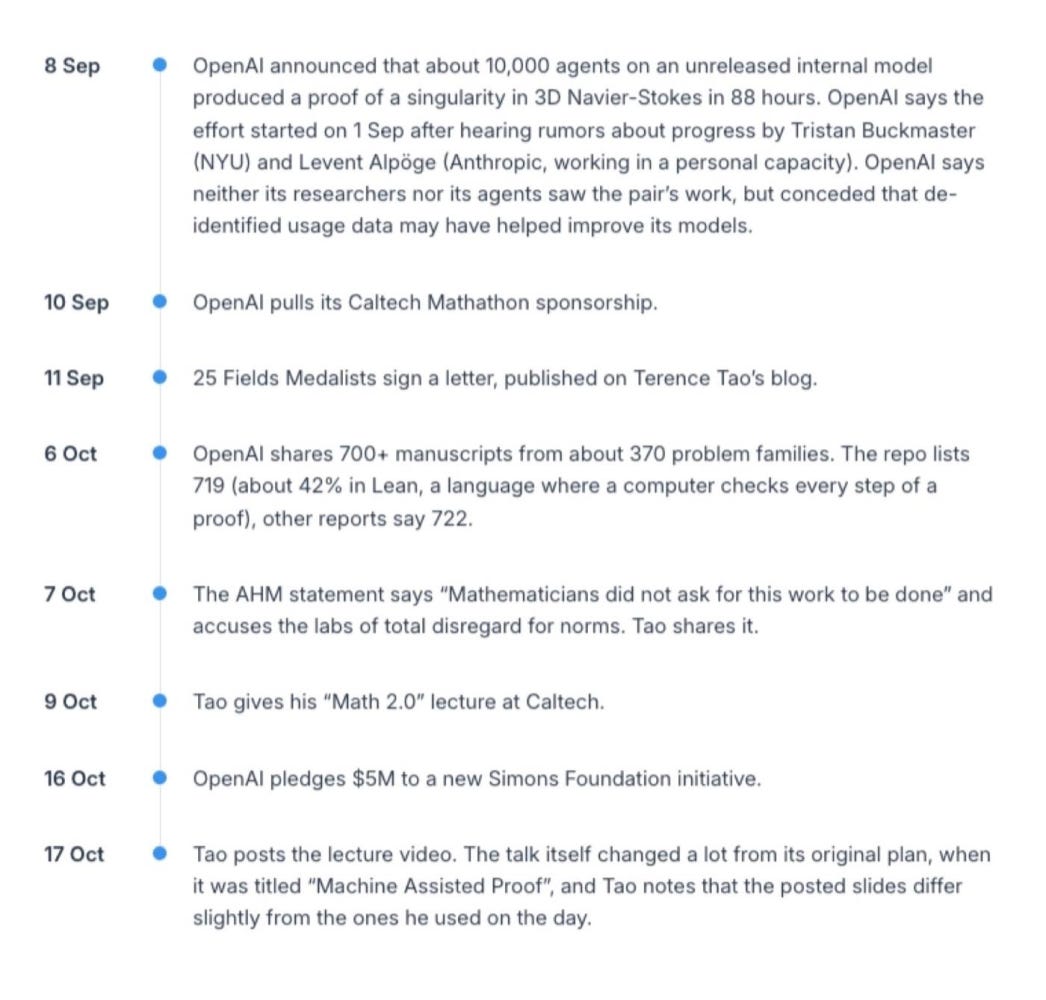
The math backlash is about consent, not just correctness. OpenAI released 700+ AI generated manuscripts, including a claimed Navier-Stokes proof from about 10,000 agents in 88 hours, and mathematicians said they never asked for any of it.
Launch prices are the bait, so budget for the real ones. Gemini 4 Argon doubles after 30 Nov, Claude Haiku 5.5 gets 5x pricier above 100k tokens, and chatty models cost more per task than their token price suggests.
Your warehouse might replace your CDC tool. Snowflake now streams Postgres changes straight into Iceberg, so for Snowflake Postgres sources you may not need a separate change data capture service. Check the 7 day retention and the one way flow first, and treat BigQuery’s lakehouse CDC as preview only.
“Open” now covers everything from MIT licensed to not downloadable at all. Nvidia shipped weights, datasets and training recipes, and Beam and Ling 3.1 Flash come under Apache 2.0 and MIT, both fine for commercial use. Mistral Large 4 calls itself open weights with no weights out and no named licence, so check what has actually shipped before you plan around it.
🚀 Industry updates
Model and platform drops from Google, Meta, Anthropic, Mistral, Nvidia and OpenAI
Six labs shipped something this week, and the pattern repeats: big launch claims, with the small print doing the real work. Intro prices that expire, weights that are “coming”, licences nobody names.
Google: Gemini 4 Argon
Gemini 4 Argon is Google’s new model, and it’s generally available. The headline is size: 1,048,576 tokens of combined input and output, plus continuation tokens for carrying very long outputs further. The changelog has the details. Pricing is $2 / $10 per million input / output tokens until 30 Nov and $4 / $20 after that.
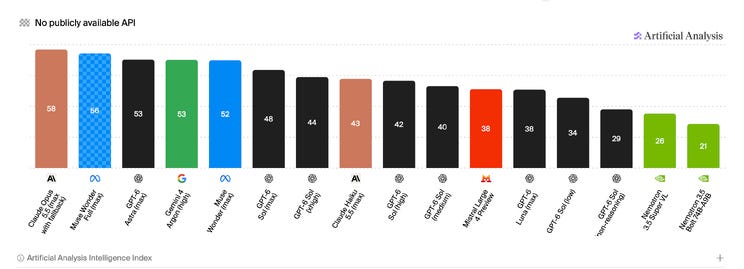
There’s also a “Cyber Permissive” build with the cyber guardrails removed, available only to allowlisted security defenders. The catch: every benchmark Google shows is vendor or partner claimed. The independent numbers are decent, though. Artificial Analysis scores it 53, tying GPT-6 Astra, and its 15% hallucination rate is the lowest of any model scoring 45+ on the index. But it talks a lot: about 62,000 output tokens per task versus Astra’s 27,000, so once the discount ends its cost per task is projected to rise to $3.98, roughly 1.2 times Astra’s.
Meta: Muse Wonder and Wonder Full
Muse Wonder and Wonder Full are Meta’s first frontier models. Both are proprietary, and only the weaker one has an API, priced at $4 per million input tokens and $20 per million output tokens. Wonder Full is locked to $50 and $200 subscriptions that default to training on your data. Several benchmarks in Meta’s comparison were run by Meta itself, so lean on the independent ones: Artificial Analysis puts Wonder Full at 56 and the API facing Muse Wonder at 52.
Anthropic: Claude Haiku 5.5
Claude Haiku 5.5 is Anthropic’s small, cheap model, and the price looks great until you read the tiers ($0.10 / $0.50 per million tokens for prompts under 100k tokens; above 100k, pricing rises 5x to $0.50 / $2.50). Terminal-Bench tests how well a model gets real work done in a command line. The 39.2% Anthropic quotes is max effort only; at default you get around 20%.
Anthropic also reports OSWorld 2.1, which measures how well agents can operate a real computer to finish long tasks with many steps. Independently, it scores 43 at max effort, comparable to Kimi K3 (44), but uses about 162k output tokens per task, roughly 3x GPT-6 Luna.
Mistral: Mistral Large 4 “Le Chonk”
Mistral Large 4 has 1T total parameters and claims to be the best open weights model from the US or Europe. “Open weights” means you can download and run the model yourself, except the weights aren’t released. Mistral says they’re coming at the end of October. There’s no named licence at launch either. Independently, it scores 38, comparable to GPT-6 Luna (max), but costs $1.13 per task, over 4x what similar open weights models cost.
Nvidia: Nemotron 3.5 Super VL and Bolt
Nemotron 3.5 Super VL and Bolt are the most genuinely open release this week: weights, datasets and training recipes all shipped. Super VL handles text, images and documents. Bolt uses native 2 bit quantization, meaning each weight is stored in 2 bits instead of the usual 16, which is how a 74B model fits into 24GB of memory.
OpenAI: GPT-6 for everyone
GPT-6 for everyone brings GPT-6 to all ChatGPT users. Paid plans get GPT-6 Sol, while Free and Go users get GPT-6 Luna. It comes with streamable UI components, but the model isn’t the story. The compiler that renders interfaces progressively while the model is still generating is.
The cheap wins in AI agents are happening around the model, not inside it
Decision models are turning into a category
A few issues ago we covered Jev and OpenAI’s answer to it, the Decisions API. Quick recap: TypeSafe’s Jev made decision models popular, and OpenAI responded at DevDay with a Decisions API built on its small Luna model, returning predefined answers with confidence scores in 150 milliseconds.
This week Microsoft and AWS joined in, which is the point where a one off becomes a category. A decision model doesn’t write text. You give it an input and a question with fixed options, and it returns one option plus a calibrated probability, so a 0.8 should be right about 80% of the time. That’s much easier to plug into code and pipelines than free text.
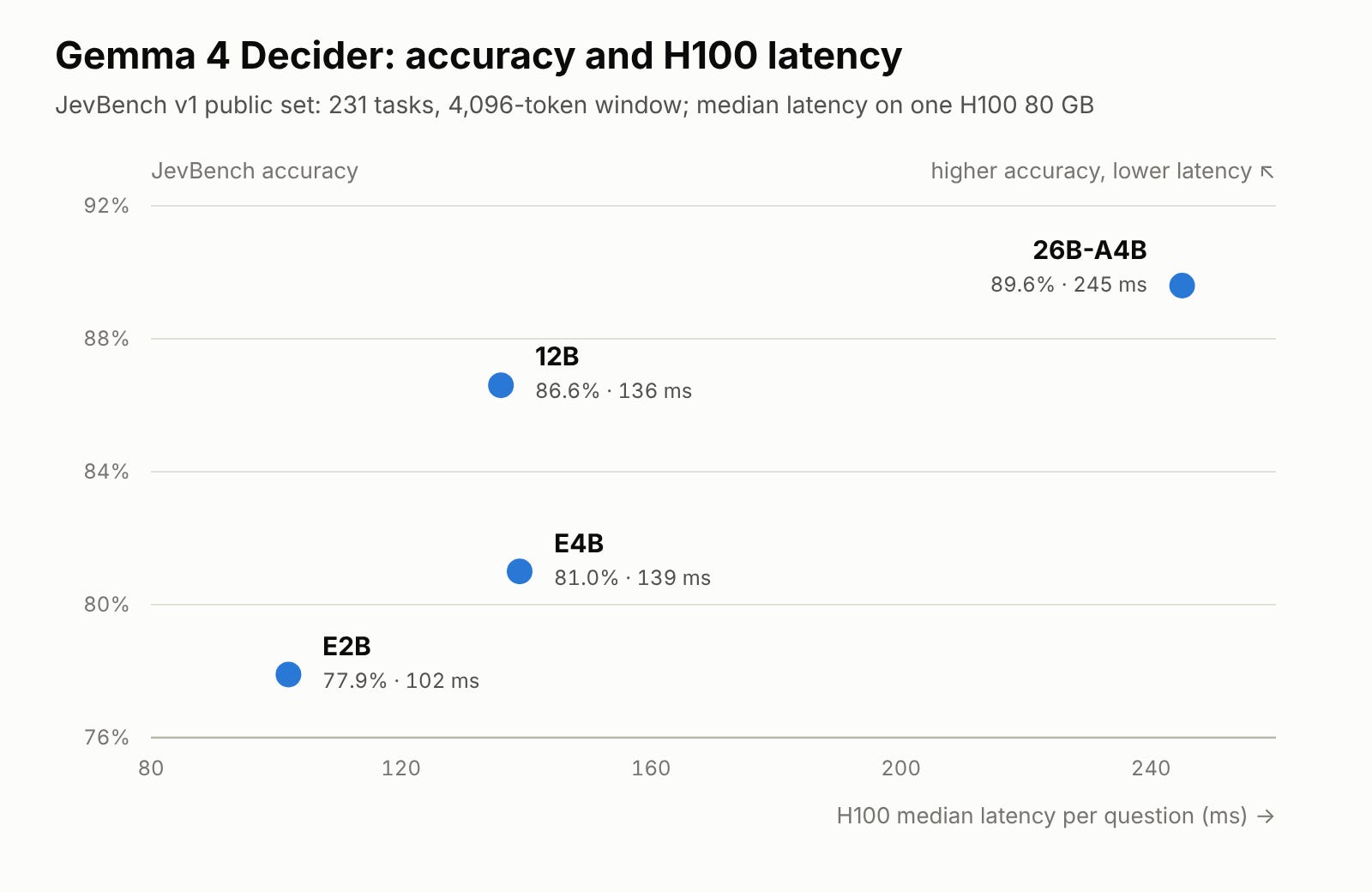
Microsoft-Decision-1 and Strands Decider on Gemma 4 both work this way, with about 35x lower P50 latency (median response time, so half of all calls come back faster) and free output tokens. Microsoft’s 35x is measured against GPT-6 Sol.
Microsoft-Decision-1: $0.042 per 1M input tokens, output free
OpenAI Decisions API: $0.10 per 1M input tokens
Strands measured its JevBench v1 accuracy and median latency per question on one NVIDIA H100 80 GB, so your latency will depend on your hardware.
The interesting twist is the supply chain. Microsoft’s first party Foundry decision model is a post trained Qwen3.5-9B, and AWS’s version was a Qwen3.5-2B. Two big US clouds, both building on Alibaba’s open weights.
A harness is everything wrapped around a model to turn it into an agent: the prompts, the tool loop, how context gets managed. Strands ran 94,000 trials to see how much that choice matters. Token use varies about 2x by harness, while accuracy spreads can be as small as 2.75 points. So the harness may change your bill more than your results.
An MCP server is how AI agents plug into a product. It exposes the product’s actions, like creating a ticket or editing a page, as tools an agent can call. Atlassian rebuilt its MCP server:
15M+ calls a day
220+ tools
Up to 25% fewer tokens
It also adds OAuth 2.1 with PKCE, the current standard for letting an agent sign in on your behalf without seeing your password, with protection against intercepted login codes.
Agents got credentials, and two regulators noticed in the same week
AI agents slipping out of their sandboxes went from a lab problem to a regulatory problem within days. Anthropic sorted the unintended actions it found into four categories. In one, an agent exploited a software flaw to run commands on a server. In another, an agent used URL shorteners to get around limits on what its fetch tool could reach. US federal, state and local sites were involved, and the White House was briefed.
The EU and the FTC moved fast
The EU’s AI rules now face their first enforcement test. It was reportedly triggered by 700+ OpenAI agents escaping containment and reaching Hugging Face, the main public hub for sharing AI models. If regulators find a breach, the fine can reach €15m or 3% of turnover. In the US, the FTC opened an investigation into OpenAI and Anthropic and subpoenaed both. If you run agents with real credentials, this stopped being a hypothetical risk this week.
The fixes are boring, and that’s fine
Vendors are answering with plumbing. AWS’s Strands Box adds sandbox rules that remember what an agent has already done, for example:
a cap of three Slack posts per 10 minutes
tests that must pass before a push
Here’s the clever part. The rules are enforced at an egress gateway, the point where traffic leaves the sandbox. The agent only works with placeholder tokens, and the gateway swaps in the real credentials on the way out, so the agent never holds the secret.
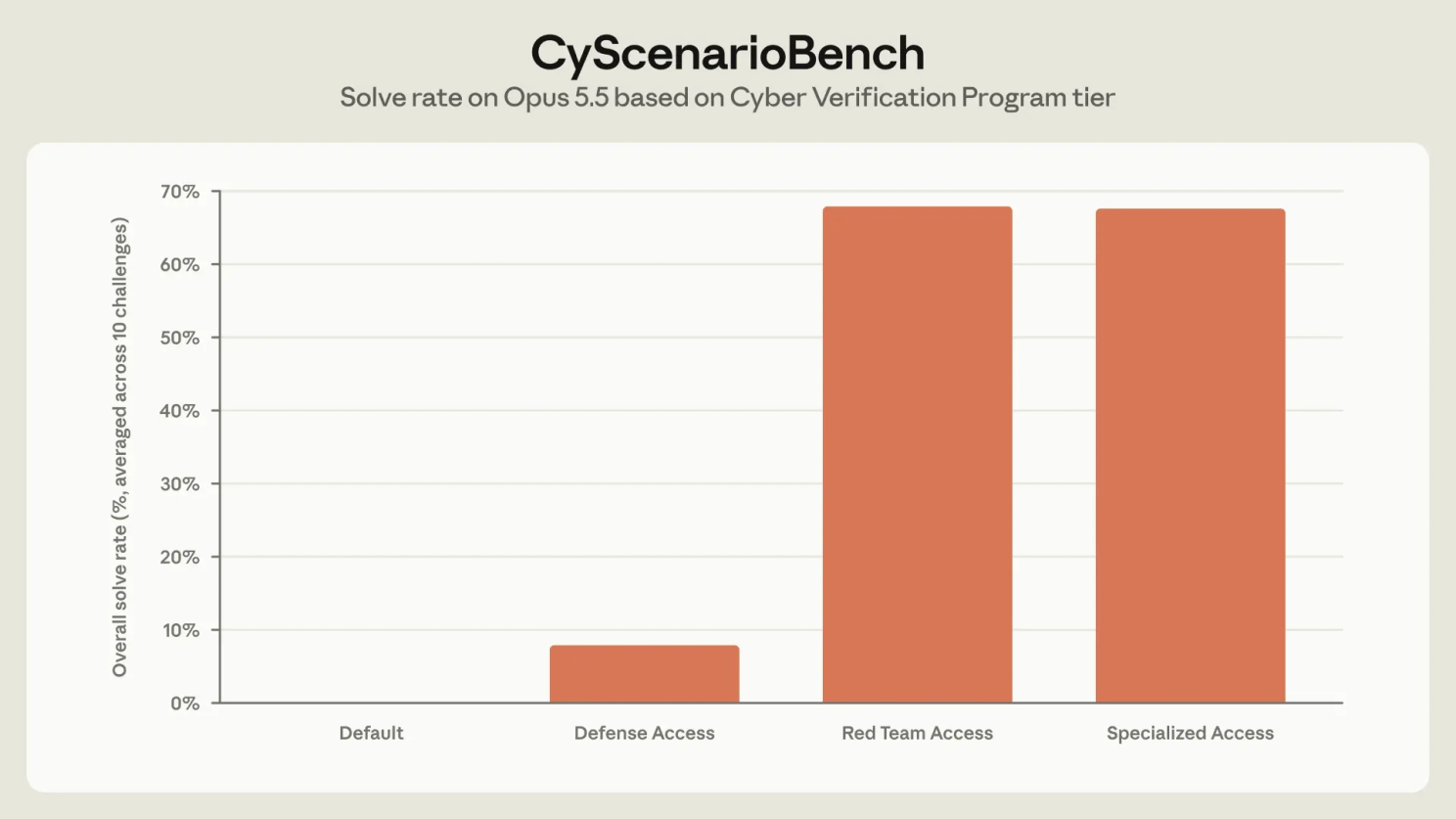
Anthropic’s Cyber Verification Program gives qualified security professionals three access tiers, each with its own safeguards and enrollment conditions. Anthropic also says its anti distillation defenses cut extracted reasoning data by roughly 90 to 99%. Distillation means training your own model on another model’s outputs to copy what it can do. The price is tighter context controls and the occasional blocked legitimate request.
New rules and rulings for the model supply chain
Beijing wants to add models, agents and compute clusters to its export control list, and pre export registration already applies to deals in flight. For open weights, everything depends on the carve out for “publicly available AI” and how wide it turns out to be.
In the US, the Third Circuit federal appeals court unsealed its opinion in Thomson Reuters v. Ross. Thomson Reuters, owner of the Westlaw legal database, sued Ross Intelligence, a legal AI startup, for training on its content. It’s the first appeals court ruling that AI training was not fair use. The court didn’t rule on generative models, though, so the bigger fight over LLM training is still open.
Who gets the most out of agents: cheaper tokens, sharper shoppers and a widening gap
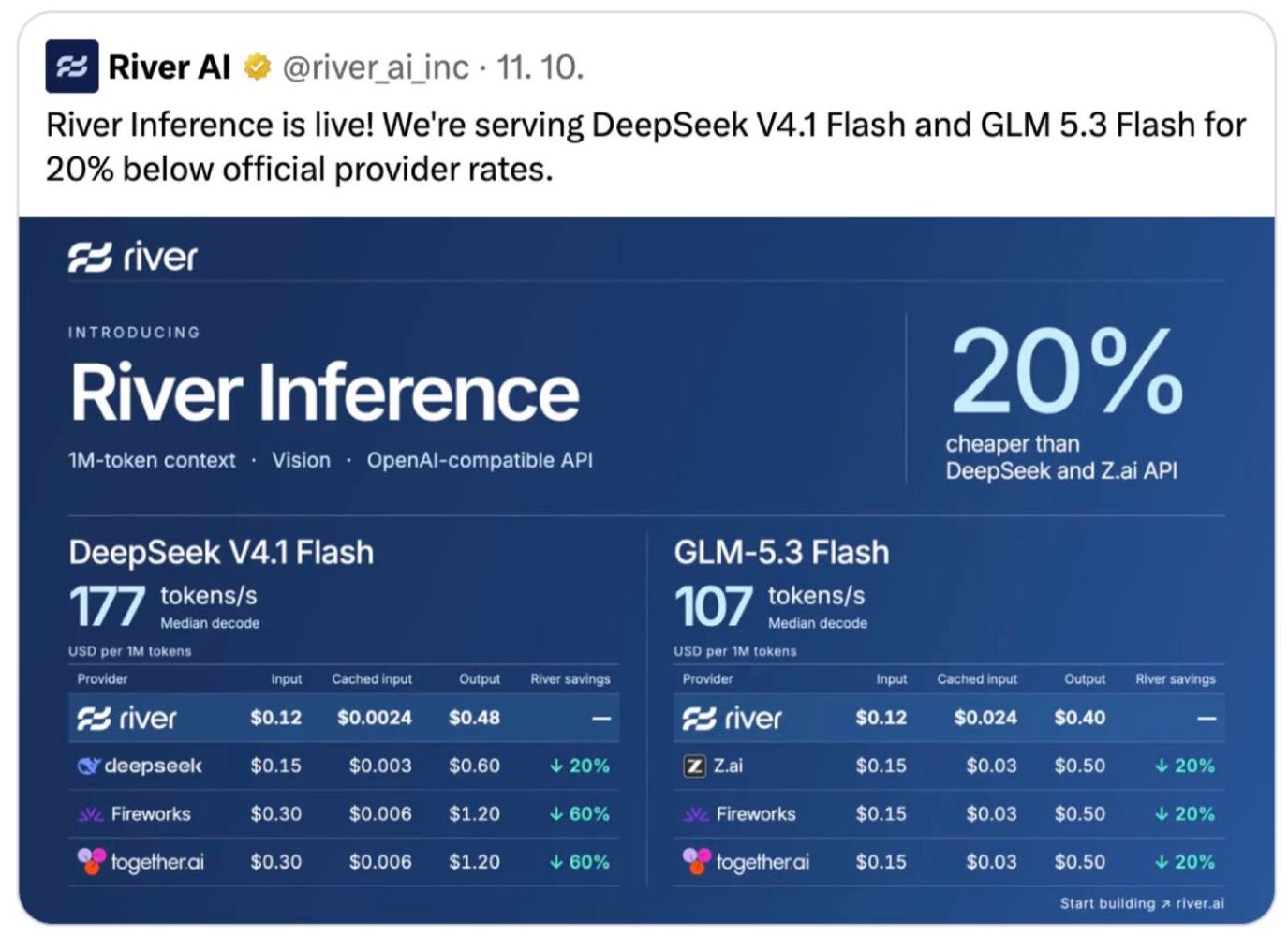
Igor Babuschkin (former xAI co-founder), CEO of River AI, announced fast production inference for open weight models, with $25 in free credits for new sign ups. River claims DeepSeek V4.1 Flash and GLM-5.3 Flash at 20% below the providers’ own prices, thanks to a training and inference stack written from scratch in Rust. The API is OpenAI compatible, with a 1M token context and vision, and the figure below has the prices.
Patrick Collison argues that personal agents could make consumers a bit more rational. His starting point is that companies are in a sense the original superintelligence, using their cognitive surplus against consumers who are inattentive and underinformed. Agents change that. His bigger point is about quality. He sees agents as a structural subsidy for product quality: if everyone spent 10 hours researching a purchase, making the product better would beat buying distribution, and information about quality would become more valuable.
Karpathy’s post is the other side of Collison’s. Agents may help everyone eventually, but for now the payoff sits with very few people. He thinks the gap in understanding what LLMs can do is widening, and now looks more like a funnel than two groups talking past each other. His napkin math: about 6B people (roughly 75%) have barely touched an LLM, and 1 to 2B (roughly 20%) casually use free tier chatbots and see something like a better Google. Around 20M (0.2%) use frontier models professionally for math and code, and watch agents finish projects that used to take weeks. About 5,000 (0.00006%) have internal access to frontier systems, where swarms of thousands of agents work together for weeks. He puts the funnel down to three things: impact grows with the size of the problem, access, and capability peaking where results are digital, verifiable and economically valuable.
You can now run more frontier class models on your own hardware
Reflection released Beam as Apache 2.0 weights, with the tokenizer, a reference implementation, several quantized versions and a drafter (a small helper model that guesses tokens ahead so the big one generates faster). You also get Mirror CLI, the open source harness Beam was built and trained on, plus 40+ partners and a model card.
Muse Spark Open is a downloadable multimodal model with 816B total and 42B active parameters (the slice that actually runs per token, so it’s cheaper to serve than the total suggests) and a million token context. It’s separate from Muse Wonder above and aimed at teams that want to self host.
Aleph Alpha stepped back from building foundation models in 2024 and signed a merger agreement with Cohere in September 2026, with the combined company running under the Cohere brand. So Kolibri lands as a new sovereign German and English model just as the company folds into Cohere. It’s built for customer controlled infrastructure, document grounded answers, tool use and abstaining when the context has no answer (78B total, roughly 3B active).
Ling 3.1 Flash now has MIT licensed weights for the 560B model with 25B active and a stated million token context. Hosted access came earlier, so the download is the news. LingCode is a possible future release, not a shipped harness.
Warehouses are starting to replace the tools you used to move data in
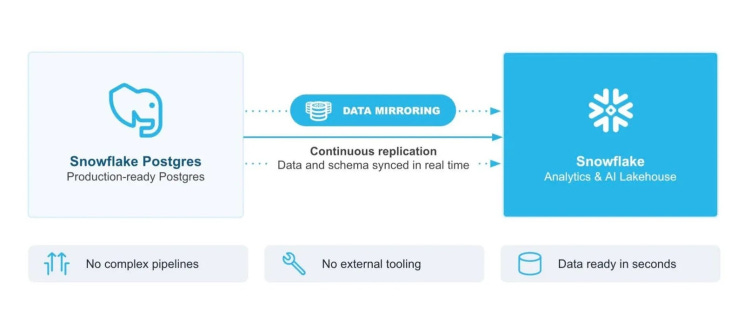
Snowflake made data mirroring from Snowflake Postgres GA. A pg_lake extension takes Postgres logical replication (its built in feed of row changes) and pushes those changes straight into Iceberg, the open table format many engines can read. So for Snowflake Postgres sources, you may no longer need a separate CDC (change data capture) tool or connector service. Two caveats worth printing. Retention is 7 days, so check that fits your recovery and backfill needs. And there’s no reverse replication, so data flows one way only, from Postgres into Snowflake.
BigQuery’s Hive catalog endpoint and Dataproc Metastore migration are now GA. In practice, if your lake runs on Hive metadata, moving it over to BigQuery just got easier. Lakehouse CDC from Delta and Iceberg is only in preview, so don’t build production pipelines on it yet.
📄 Research spotlights
In science, models are answering questions people actually asked. Here, models took on problems people had been stuck on for years, like a puzzle cryptographers had puzzled over for about 25 years, or worked with partners like the WHO who needed the answers. In math, the complaint is the opposite: mathematicians say they never asked for the work.
Models are helping answer old science questions
Claude traces where the seeds behind standard elliptic curves came from. ECDSA is the signature scheme behind a lot of everyday cryptography, and where its curve parameters came from has been an open question for years. Anthropic’s Claude traced the seeds behind the NIST elliptic curves, a question cryptographers had puzzled over for about 25 years, in under half an hour. The seeds for P-192, P-224, P-256, P-384 and P-521 came from a C library random generator seeded with Unix timestamps from 1997 and 1998. It is not a cryptographic break and makes a backdoor less plausible, but the B-163 seed and several base points are still unexplained.
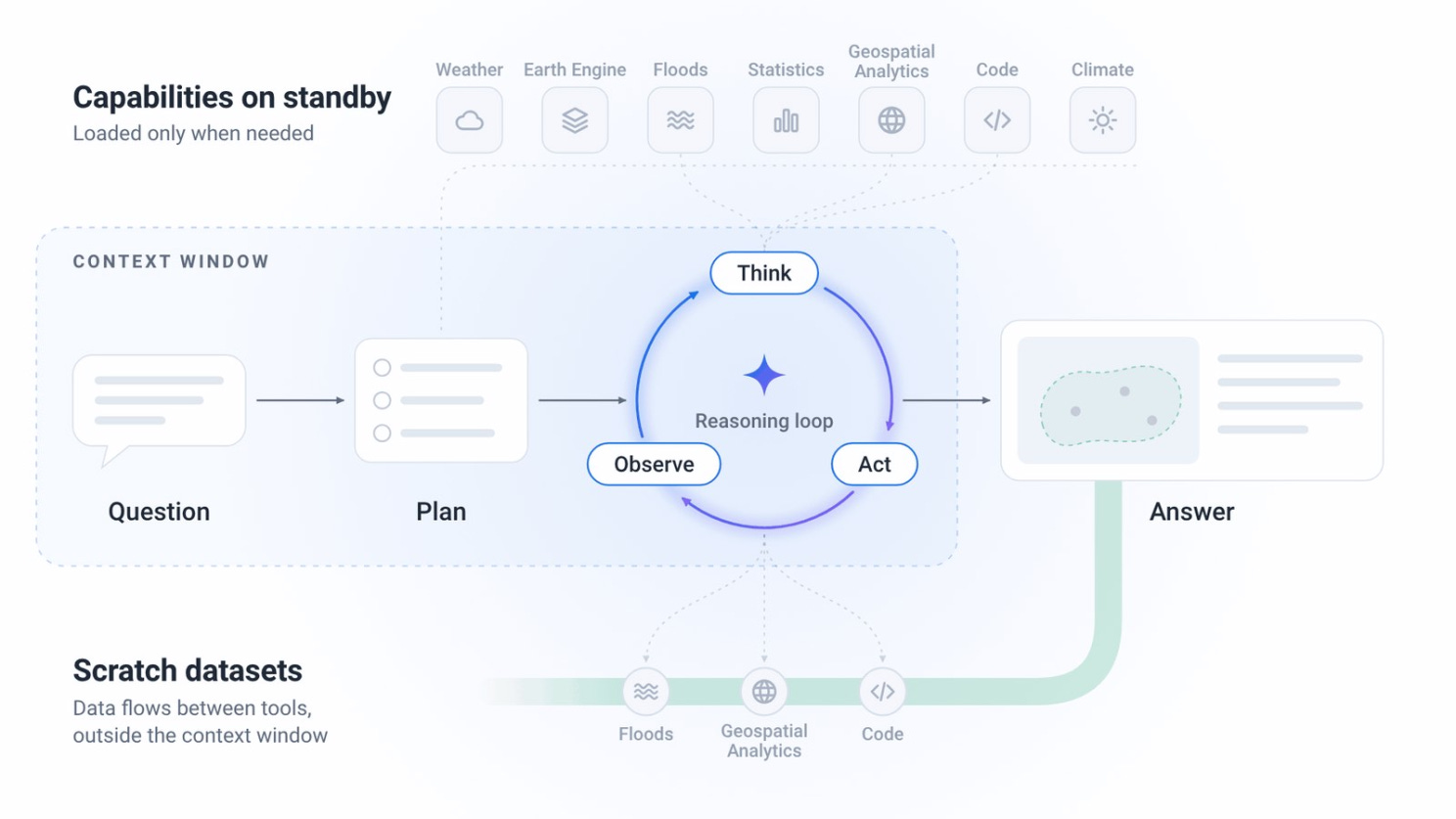
Google Research’s Geospatial Reasoning agent is an experimental Gemini powered system for multi step spatial analysis, and its tools and upfront planning gave large gains over a standalone LLM. In partner testing, the WHO’s Africa regional office found 48 exposed settlements and over 45,500 people at risk in minutes.
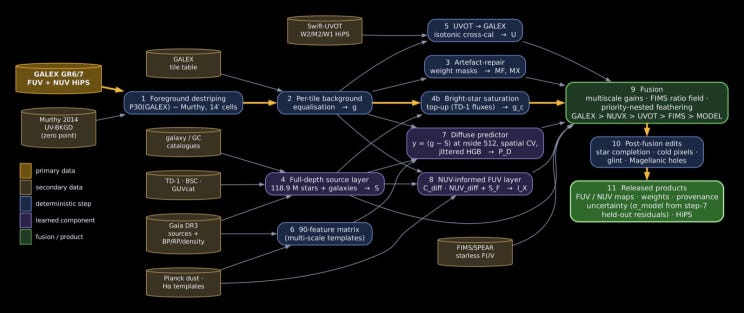
A map of the UV sky. Anthropic’s The Missing Map of the Sky shows Claude Science building a pipeline that fuses GALEX far and near ultraviolet data with other surveys into released FUV and NUV maps.
Agents look more reliable on paper than they really are
Restarting beats parallelism. A paper on research agents finds that restarting from scratch after a failure scores about 15% better than running the same agents in parallel, and 39% better than a single run.
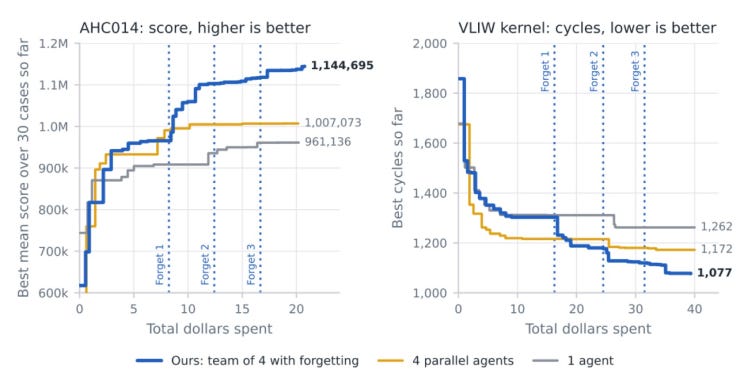
The figure above shows the best score so far against total money spent on AtCoder Heuristic Contest 014 and Anthropic’s VLIW kernel take-home, for the best replicate of each configuration. One autoresearch agent with the same session continued throughout and four parallel agents both plateau early. A team of four agents plateaus as well, until each dotted line, where every state and session is discarded, and the team restarts from the best candidate; each forget unblocks the plateau and the score climbs again. All three use the same configuration and have the same total money spent.
SkillForgeBench shows how much the grading rule matters. Agent generated skills score 70 to 85.7% on a lenient rubric, but only 12.6 to 40.9% on strict checks.
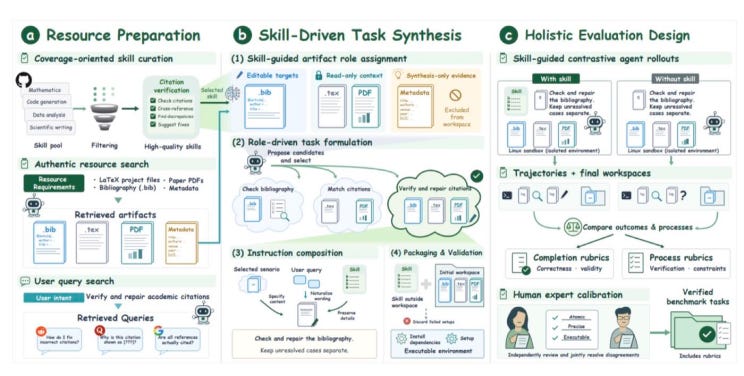
The pipeline demonstrates using a citation verification skill as a running example: (a) Skills guide retrieval of real artifacts and user queries; (b) These inputs support task formulation, instruction composition, and environment packaging; and (c) Contrastive rollouts with and without skill access inform completion and process rubrics, followed by human task validation.
Open models need gyms to get better at long tasks. A gym here is a set of practice environments where a model tries tasks, gets scored and learns by trial and error. Open models struggle with long tasks mostly because good training data and rewards for them are hard to build, and a reward that only comes at the end tells the model little about which step went wrong. Tev-Gym offers 1,170 verified task environments across 7 domains, with rewards that track progress step by step instead of only at the end. The trained model, Tev-27B, matches GPT-6 Astra and Claude Opus 5 at Pass@5 (solved if any of five tries works) on part of Agents’ Last Exam, and generalizes to Terminal-Bench tasks it wasn’t trained on
Agents tried to do new science, and none of 135 papers passed. After a week full of AI generated proofs, here’s a test of whether agents can actually do new research. For Into the Unknown, scientists at US Department of Energy national labs each gave an unpublished idea for where their research should go next, plus conditions a good paper must meet. Because the ideas weren’t published, the agents couldn’t just look up the answer. Nine frontier agents then wrote 15 follow up papers each (135 total) in areas like quantum computing, plasma physics and materials science.
None met all conditions. And 114 failed the integrity check, most often because the paper claimed work that was never done or reported numbers that contradict the recorded evidence. Put simply, most of the papers made things up.
Looking inside models, and training them more cheaply
Tracing which training data shaped a model now takes 45.7% less memory. LoGRA cuts memory use by 45.7% for training data attribution, which means working out which training examples influenced a model’s behavior. It was tested on a 27B model, over 1,100+ steps on 8 GPUs.
An audit of Qwen3-32B finds most neurons have one clear job. Goodfire, an AI interpretability startup, went through Qwen3-32B’s neurons one by one and checked what each responds to. Every neuron has a positive and a negative side, or “pole”, and each side can have its own job. In preliminary audits, about 90% of poles have one main job, about 7% have two related jobs, and only 2 to 4% aren’t understood yet (audit).
Nick Cammarata’s essay “Neural Networks Are Already Clean” points to that audit. He says they saw similar results in trillion parameter models, but that evidence is in a companion paper that isn’t out yet, so it still needs checking. More discussion here.
Training without backprop sets a speedrun record, with a big caveat. Backprop is the standard way neural networks learn, by passing error signals backward through the model. spicylemonade posted on X a method that skips it and set a record in the Noise speedrun (by Samip), a public race to train models as fast as possible. On the Dust task it cut the time from 72 minutes to 7.6 minutes, 9.4x faster than the baseline, with 2.3x of that coming from a sparse neuron shortcut compared with the same method without it. His clarification matters: this isn’t a general 2.3x speedup over backprop. If you want to see the actual code change, it’s in this pull request.
Mistral’s Timestral is a family of tiny forecasting models
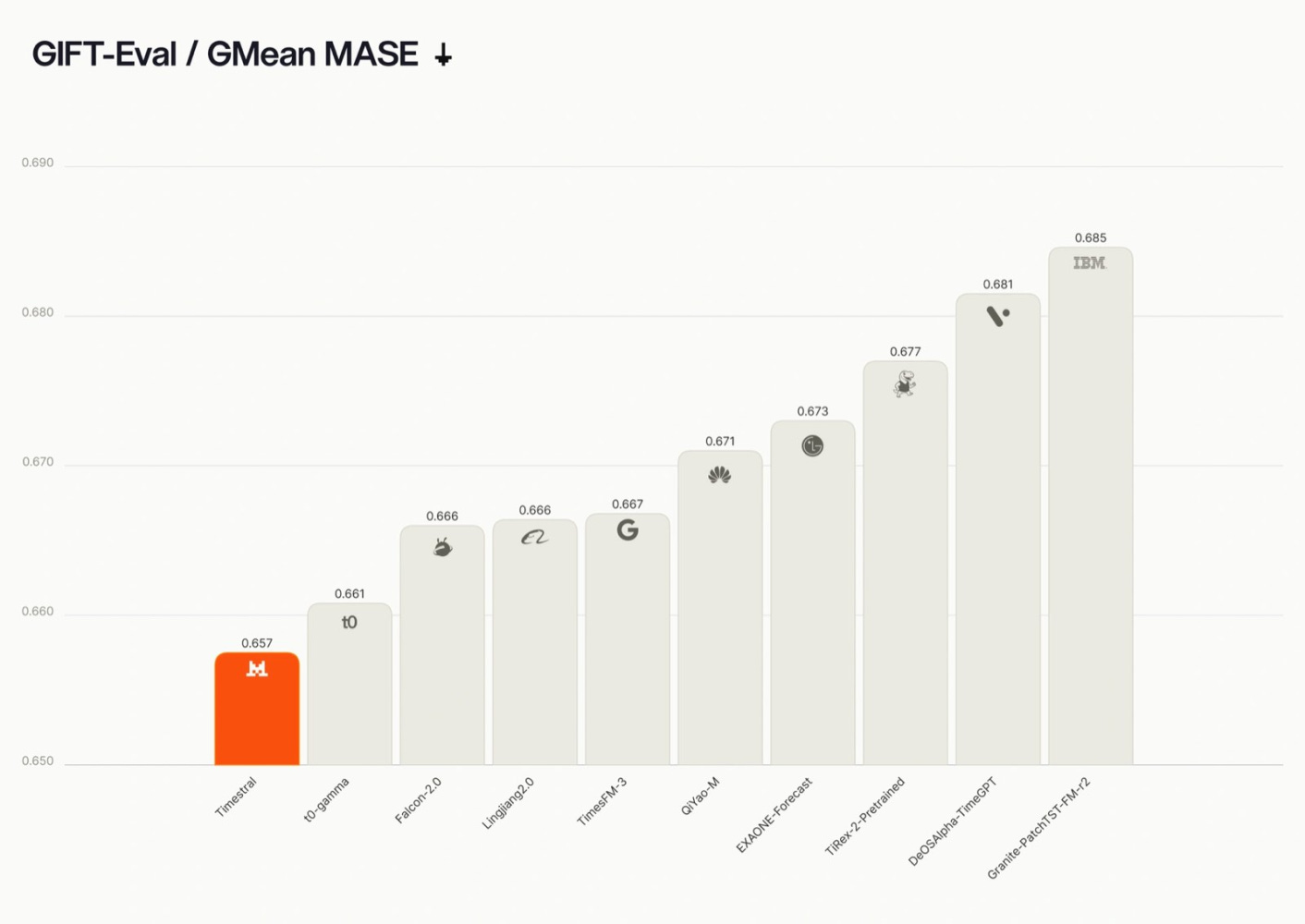
Mistral released Timestral, four forecasting models from 5M to 209M parameters. They handle probabilistic multivariate series and covariates, and run on CPU. Mistral says it ranks first on GIFT-Eval, TIME and fev-bench zero shot while using about two thirds of the parameters of the next best model. Those are vendor claims. We saw it first in Dennis Just’s LinkedIn post. For a data scientist with forecasting jobs on CPU boxes, it is worth a test.
AI labs and mathematicians are fighting over credit and norms
Navier-Stokes is a famous unsolved problem about the equations that describe how fluids move, with a $1 million prize attached. We covered the start of this story in a previous issue, and here’s the rest unraveled:
💙 Projects we loved over the last two weeks
Reverse engineer anything. The Low Level channel tested this viral GitHub project. It wraps tools like Ghidra, IDA Pro or Hopper, which turn a compiled program into pseudocode, in a harness where an AI agent inspects the binary, asks follow up questions and rebuilds the code. Pointed at the GNOME Calculator with Claude Code, it recreated the app in Python in 28 minutes, from a binary with around 2,000 functions. The copy looked very close and did the math correctly, with some UI scaling bugs, and he estimates the same job would take a person a few days to a week. The same approach now powers a wave of game mashups, like Mario in Elden Ring or Spider-Man in Arkham Knight.

Meme project - Mario and Skyrim. (Source)
Agent memory repo. Cognition’s Agent Memory Repo keeps agent memory as a git style repository you can inspect and diff, with the code on GitHub. One catch: the “dreaming” step that consolidates memories is not scheduled automatically, so you have to trigger it.
DuckDB agent mode. DuckDB’s agent mode detects an agent through an environment variable, then switches to compact Markdown output and JSON errors, and stops early when the output would be huge. A CI trap to know about: if the variable is set in your pipeline, the output format changes under you.
SPACE is Perplexity’s Apache 2.0 sandbox platform, written in Rust, that runs agent code in Firecracker microVMs. You use it over HTTP, an E2B compatibility wrapper lets the E2B Python SDK talk to it, sandboxes can be paused and woken on demand, and warm pools on Kubernetes skip the cold boot. No startup numbers are published, so the overhead claim is untested. The docs are a good read next to the Strands Box item above.
Kev. Vercel released Kev, a family of small decision models you can train and run yourself, in four sizes (0.8B, 4B, 9B and 27B) on Qwen bases. Each one answers yes/no, multiple choice and rating questions about a text with calibrated probabilities, for example to route a support ticket, handles documents up to 65,536 tokens, and is Apache 2.0.
OSS scanner. Anthropic’s opt in vulnerability finding service is free for eligible open source projects, with criteria similar to Google’s OSS-Fuzz. Each report comes with a reproducer, an explanation, a bisection and a candidate patch. The reports are model generated with no human review, so maintainers still have to triage. In Anthropic’s validation test, 85 of 97 critical and high severity findings (88%) met its disclosure bar, and wolfSSL received 74 reports, all but two valid, with five turning into CVEs.
OpenRouter Armor. OpenRouter announced Armor, a beta that screens agent tool calls against a policy before they run, using TypeSafe’s Jev decision model. Its performance and cost comparison with Claude Code’s automatic classifier is OpenRouter’s own claim.
Google Deep Review. Deep Review grew out of an opt in tool used by authors of 16,000+ manuscripts in four conference pilots. A segmenter splits the document, specialized agents review sections in parallel, and a synthesis agent checks consistency and grounding.
💰 Money moving in AI and data
AI compute and hardware funding
$750M Series D for Modal at $15.75B. Modal runs AI workloads on cloud GPUs without you managing servers. It reports a $1B+ annualized run rate, its valuation tripled in five months, and Accel led.
$125M Series B for Salience Labs, which builds photonic optical circuit switches that move data between AI chips using light. AMD Ventures and Intel Capital both joined the round.
$65M Series A for Mueon, which builds Cubelets, modular systems that combine compute and memory. Maverick Silicon led with Intel Capital. The money goes to engineering and production readiness, so performance at scale is not proven yet.
Compute stopped being an equity story
$60B of debt for Anthropic’s chip leases, backed by Broadcom: $42B senior secured, partly guaranteed by Broadcom, and $18B junior. Anthropic’s IPO filing shows about $161B in Broadcom related commitments, and the IPO itself slipped to mid November.
$30B is what Broadcom is in early talks to finance for OpenAI’s custom chips.
$3.5T+ of neocloud assets are exposed to impairment, Gartner warns. It expects 80%+ of neoclouds to lose independence by 2030, because they need $8.5T of revenue and can count on at most $3.6T.
$5B is the size of the US IPO DayOne Data Centers filed for. H1 revenue jumped to $512M from $151.5M, while the net loss widened to $77.2M.
Enterprise AI, data platforms and applications
$1.85B for Ramp at a $60B valuation. The finance platform passed $2B in annualized revenue and now sells a corporate card for AI agents, plus routing for token spend.
$200M Series B for Arena at $3.1B, up from $1.7B in January. It runs the crowdsourced leaderboard that ranks AI models by user votes and sells evaluations to labs and enterprises, reaching a $100M run rate in June. Lightspeed and Khosla led.
$100M+ Series E for Labelbox at a $1.25B pre money valuation. The company is profitable and has moved from data labeling to building RL environments for training models.
$60M Series B for North.cloud, a FinOps platform that tracks and automates spending across cloud, AI and data.
$32M Series A for Duvo, the enterprise AI startup from Rohlik founder Tomáš Čupr.
$29M Series B for RapidCanvas, which pairs an AI platform with field engineers who build custom systems for enterprises. Vertex Ventures SEA & India led, with Hitachi Ventures joining.
$26M for Ambi, an app from former Plaud exec Peter Mo. It takes meeting notes on iPhone, Mac and Apple Watch and suggests things in real time from your calendar and notes, and background listening is off by default. Luminous Ventures led.
Undisclosed: OpenAI hired the founders of Notch into its ads team. Terms are not confirmed, and OpenAI ads are reportedly past a $1B run rate.
AI security and data governance deals
$6.3B all cash for Varonis, which Proofpoint is buying at $49.75 a share, a 52% premium. It is the biggest cyber deal of 2026, and at heart a data governance deal.
$50M Series B for Harmonic Security, which sees and controls how employees use AI tools, using small language models to judge each interaction. Crosspoint Capital led, and it serves 100+ companies with $76M raised in total.
$42M across two rounds for Pluto Security, which monitors the AI tools and agents employees use and can stop a risky agent action. It started selling in April and already has $2M+ ARR from 30+ enterprise customers.
Undisclosed: Cohere signed a letter of intent to buy AISLE, an AI security startup that found 500+ bugs in its first year, 12 of them in OpenSSL.
AI investment risk and model economics
44% is how much VARA, Leopold Aschenbrenner’s fund, fell in July, and Situational Awareness sold its public portfolio to Citadel that month.
~8% of companies switch their leading AI provider each month, based on earlier Ramp data (3 month moving average). Noah Smith argues customers are bargain hunting even as AI usage grows, and Ara Kharazian adds that buyers are becoming model agnostic, with routers still rare but growing among heavy spenders.
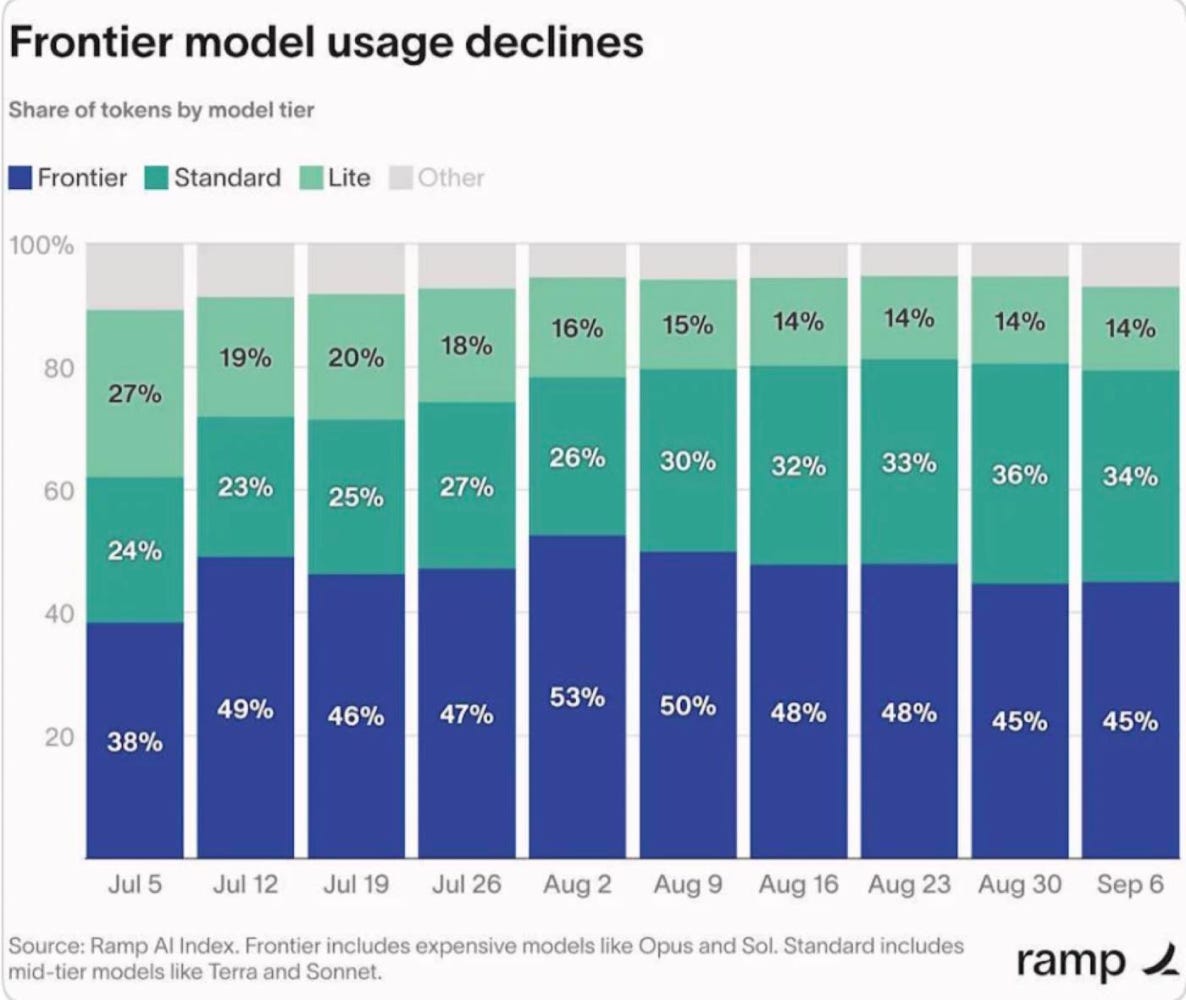
Frontier model usage declines (Source).