

This fortnight in AI was like the one thing Dario Amodei hates most: peak social media. Blocking, fat jokes, and bling.
Frontier capability is now a compliance leash and a live test of export sanctions: play ball, or use dumb AI. 72 hours after launch, the US government locked everyone out of Fable, reportedly including Andrej Karpathy, who couldn't touch the model he was hired to build. It's unexpected proof of Satya's point that most companies are building on sand, renting intelligence rather than owning it. The smart hedge is the open-weight floor, which keeps rising: MiniMax M3 unified frontier coding, 1M context, and multimodality in one open model, and Cohere shipped an open-source, frontier-class enterprise MoE.
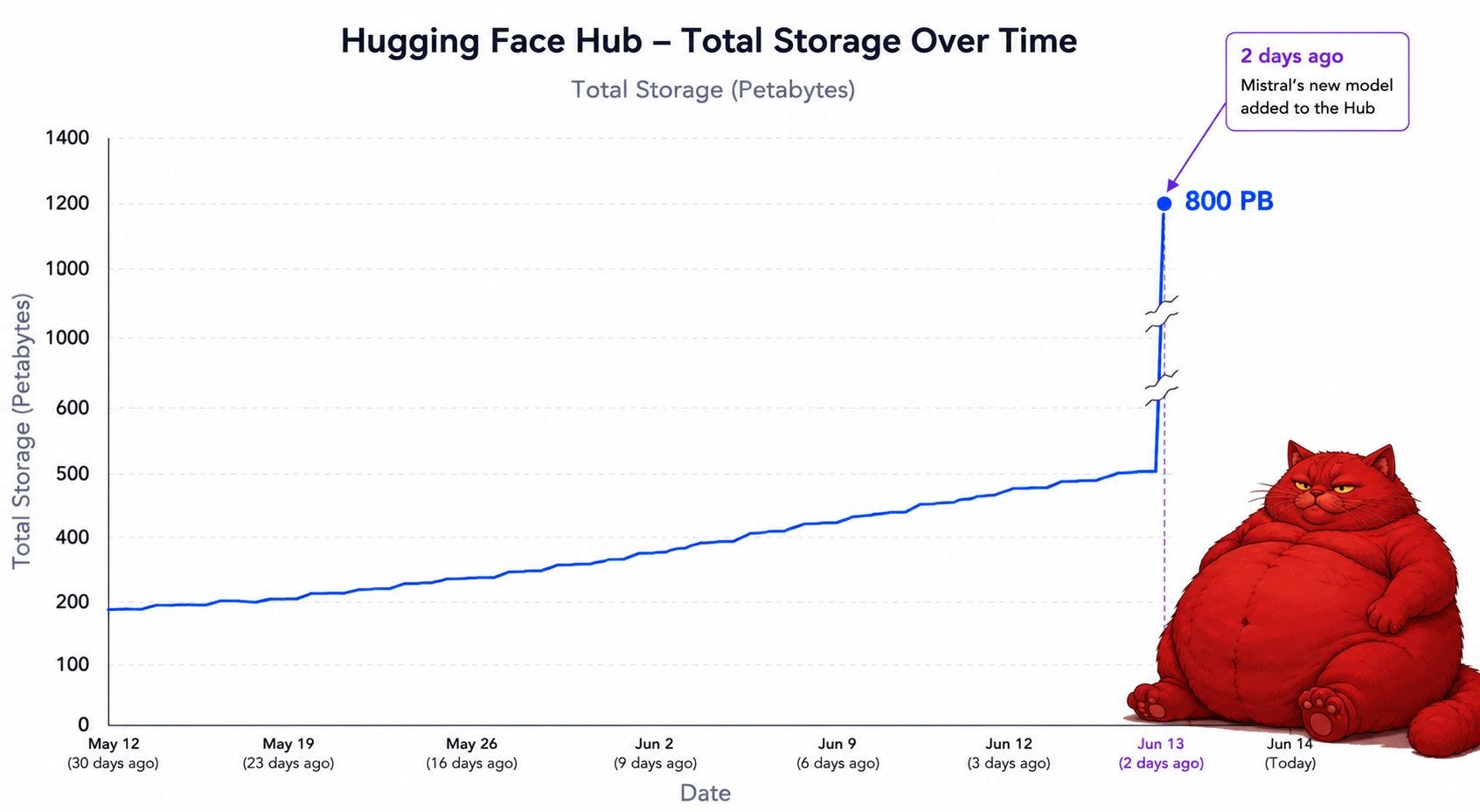
Sovereignty is the other escape route. The EU banned Claude from parts of its public sector, giving Mistral a tailwind it couldn't have bought, as it scales into much larger, sparser MoE architectures. A good comeback for a company whose latest round of positive coverage was that "Le Chaton Fat" (a fictional 30-trillion-parameter supermodel) was "so fat it broke Hugging Face's S3 bill."
The infrastructure story underneath is just as stark. While everyone compared notes on Databricks' and Snowflake's latest releases, SpaceX walked into its IPO with $2.17B in monthly committed compute from Google and Anthropic, and bought Cursor for $60B. Cursor's founders and first 200 employees hereby exit the permanent underclass.
Everyone is building on someone else's foundation. The only question left is whose, for how much, and who can ban it.
Key takeaways:
The US government pulled Anthropic’s two most capable models offline with 90 minutes’ notice over a narrow jailbreak, and Andrej Karpathy was locked out of the models he was hired to work on because he isn’t a US citizen.
If you can’t swap out your AI model without losing your institutional expertise, you’re renting intelligence, not building it, and Satya Nadella describes most companies as doing exactly that.
SpaceX enters its IPO as the most important AI infrastructure company in the world, with $2.17B in monthly committed revenue from just Anthropic and Google, while also partnering with Cursor.
The EU’s ban on Anthropic’s Claude in certain public sector deployments hands Mistral a regulatory tailwind it couldn’t have bought, at exactly the moment it has the infrastructure to back it up.
If you can’t swap out your AI model without losing your institutional expertise, you’re renting intelligence, not building it. Satya Nadella argues most companies are doing exactly that.
🚀 Industry updates
Satya Nadella: Companies that let AI absorb their knowledge without owning the loop will lose everything
Microsoft CEO Satya Nadella published an essay this week arguing that the real competition in AI isn’t about which model wins; it’s about which companies build self-learning systems they actually own. His central idea is that every firm now needs both human capital (judgment, relationships, pattern recognition) and token capital (owned AI capability), and that these compound together rather than trade off.
The practical test of whether a company actually owns its AI is simple: can you swap out the underlying model without losing the expertise your organization has built? If not, you’re renting intelligence rather than building it. Nadella argues firms need private evaluations against their own business outcomes, internal reinforcement learning on real organizational data, and architecture that keeps institutional knowledge portable.
The essay closes with a warning drawn from the first wave of globalization, when outsourcing hollowed out industrial economies while GDP numbers looked fine on the surface. Nadella sees the same risk in AI: a handful of frontier models capturing all economic returns while entire industries find their accumulated knowledge commoditized beneath them.
Anthropic launches its most capable models ever, then watches the US government pull them offline three days later
Anthropic released Claude Fable 5 and Claude Mythos 5, its most capable models to date. Fable 5 is described as exceeding any model previously made generally available, with state-of-the-art results across software engineering, knowledge work, vision, and scientific research. In one early test, Stripe used it to migrate a 50-million-line Ruby codebase in a single day, a task that would have taken a full engineering team over two months by hand. Mythos 5, built on the same underlying model but with fewer restrictions, was reserved for vetted organizations through Project Glasswing and priced at $10 per million input tokens and $50 per million output tokens.
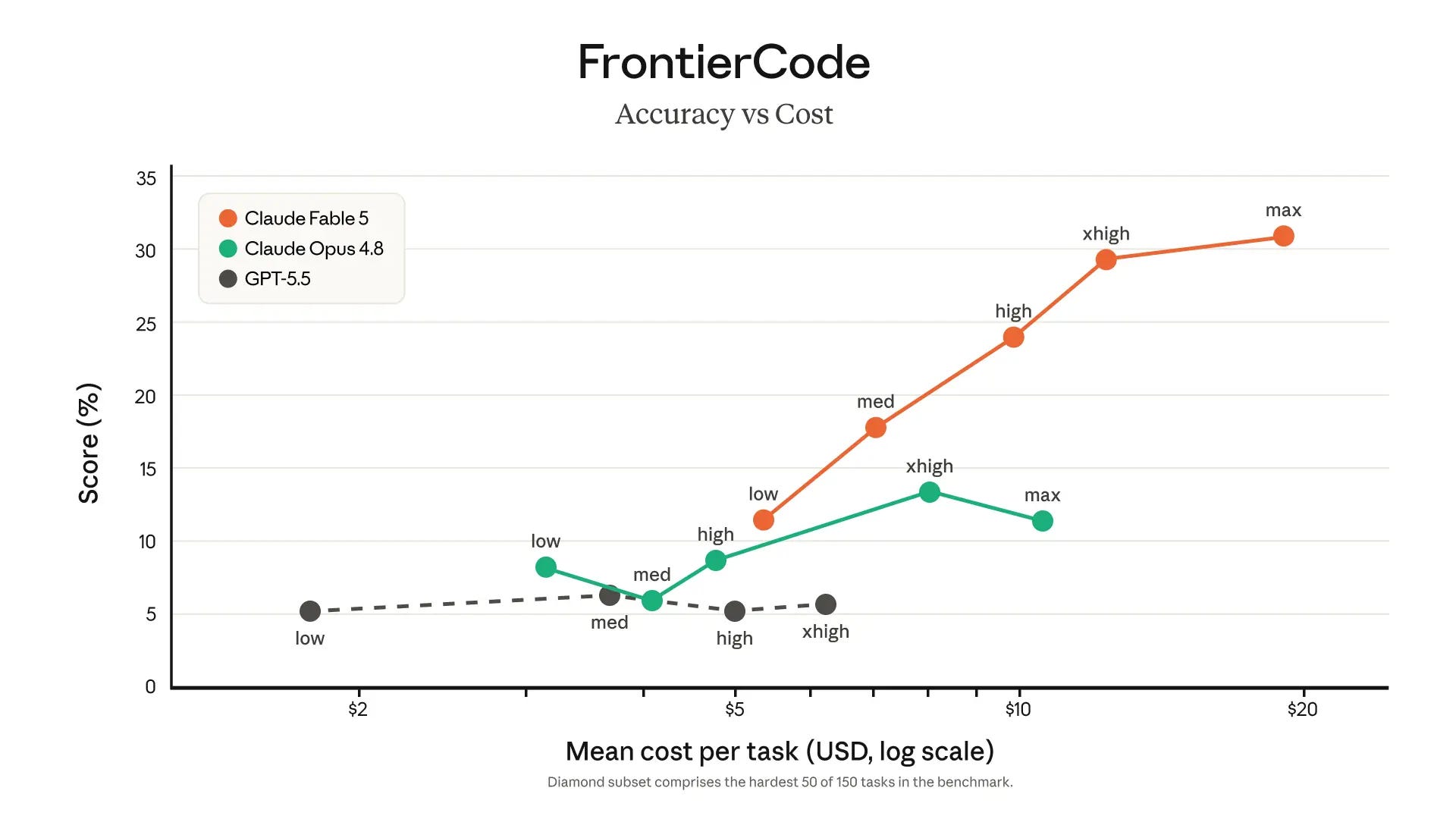
Three days later, the US Commerce Department issued an export control directive ordering Anthropic to suspend all access to both models for any foreign national, whether inside or outside the United States, including Anthropic’s own non-US employees. Because Anthropic had no way to filter users by nationality in real time, it had to pull the models offline for everyone globally, with 90 minutes notice. All other Claude models remained available.
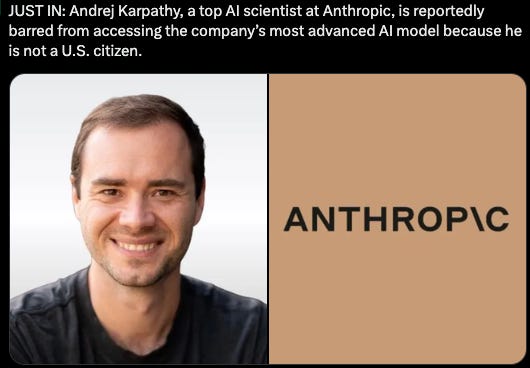
The collateral damage was immediate and symbolic. Andrej Karpathy, one of the most respected AI researchers in the world, who joined Anthropic’s pretraining team just weeks earlier, was reported to be locked out of the models he was hired to work on because he is not a US citizen. The rumor doesn’t hold up cleanly, though: Karpathy reportedly holds an EB-1 green card, which classifies him as a “US person” under export control law, meaning the directive should not have applied to him in the first place.
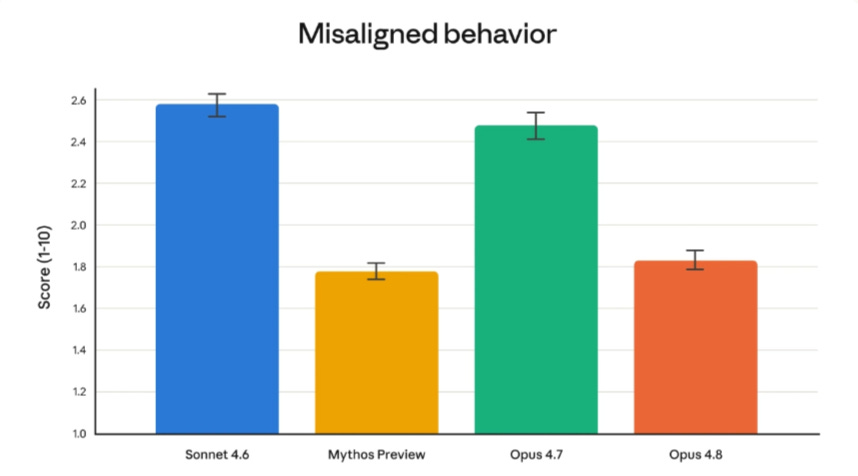
The company stated it disagreed with the decision, arguing the jailbreak cited by the government was narrow and non-universal. Noted that the same level of capability is available from other deployed models, including OpenAI’s GPT-5.5, and said that if this standard were applied consistently across the industry, it would effectively halt all frontier model deployments.
The practical side effect was also significant for enterprise users. As Mike Taylor noted, Fable 5 came with a mandatory 30-day data retention policy including human review, and its memory feature searched past conversations by default. Any organization that used Fable 5 with memory enabled and had active NDAs in place was effectively sharing confidential chat history under those terms.
On a separate but related note, Anthropic also released Claude Opus 4.8, an upgrade to the Opus class with stronger coding and agentic performance at unchanged pricing of $5 per million input and $25 per million output tokens. Opus 4.8 scored 84% on the Online-Mind2Web browser agent benchmark and was reportedly around four times less likely than Opus 4.7 to let code flaws pass unremarked.
MiniMax releases M3: first open-weight model combining frontier coding, 1M-token context, and native multimodality
MiniMax M3 - native multimodal model supporting image and video input, computer use, a 1M-token context window via the new MSA (MiniMax Sparse Attention) architecture. On frontier-level coding scores, marked as the first open-weight model to unify all three capabilities. The architecture numbers are significant: at a 1M-token context, per-token compute is 1/20th that of the previous generation, with MSA delivering more than 9× speedup in prefilling and more than 15× in decoding versus full attention.
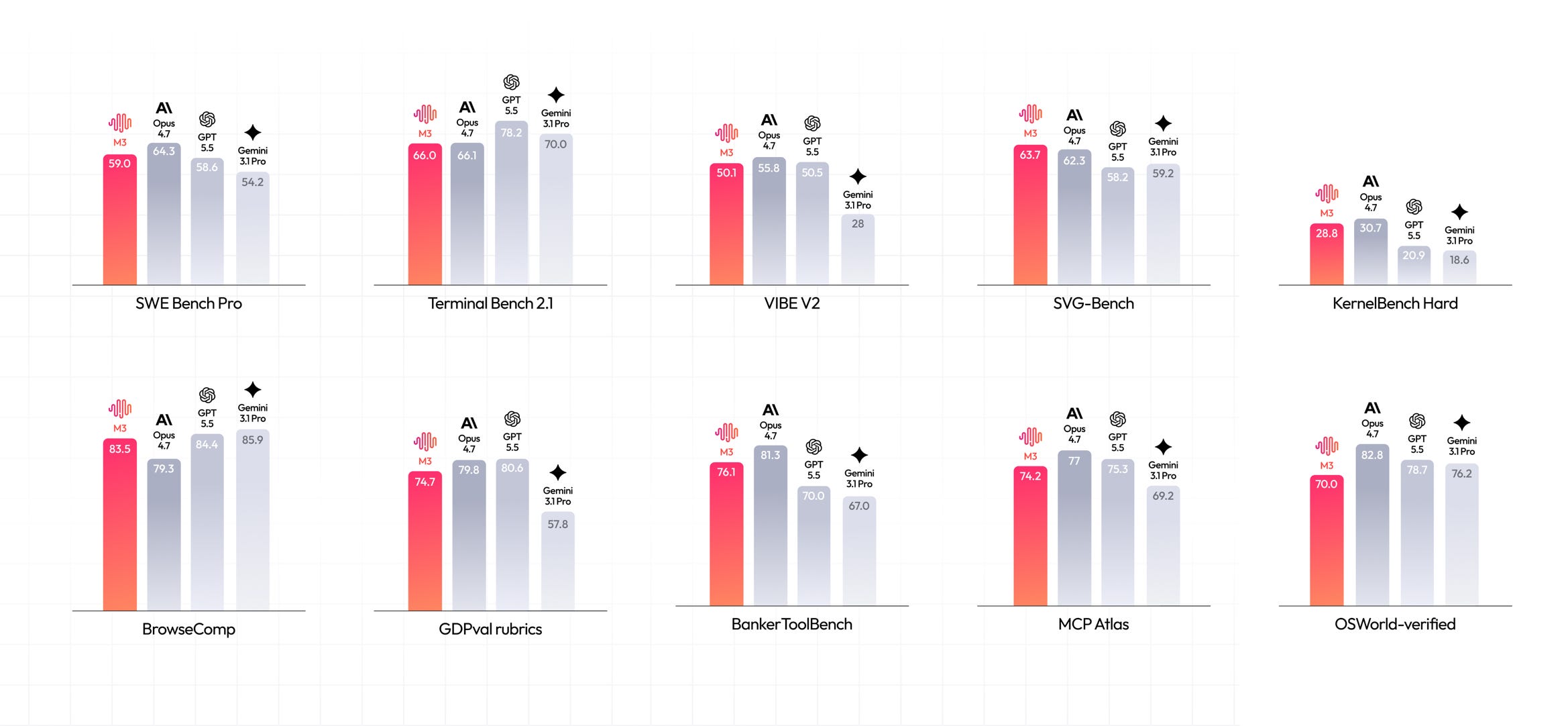
The release also includes a real-world demonstration where M3 autonomously ran a CUDA kernel optimization over 24 hours, completing 147 benchmark submissions and improving Hopper FP8 hardware peak utilization from 7.6% to 71.3% without human intervention. This signals that long-horizon autonomous engineering work is crossing a practical threshold, and the decision to open-weight the model will increase pressure on closed-source labs to justify their pricing premiums.
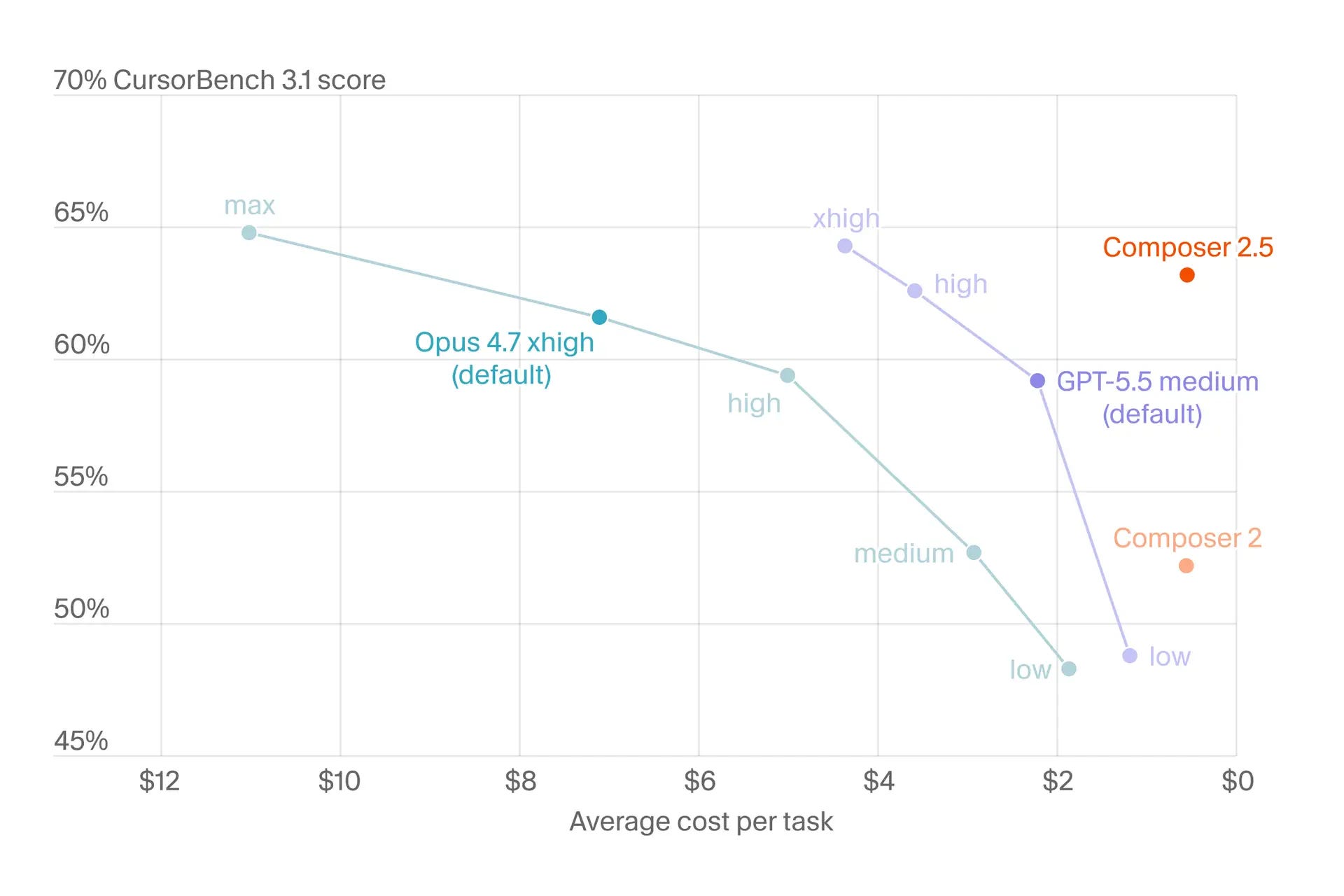
Cursor releases Composer 2.5 with targeted RL feedback and 25× synthetic data scale, priced at $0.50/M input
Composer 2.5 is built on the same open-source checkpoint as Composer 2 (Moonshot’s Kimi K2.5) and introduces two main training improvements: targeted RL with textual feedback, which inserts localized hints at specific trajectory steps to correct individual model behaviors without degrading the broader RL objective; and 25× more synthetic tasks than Composer 2, generated dynamically from real codebases. Pricing is $0.50/M input and $2.50/M output for the standard tier, with a faster variant at $3.00/M input and $15.00/M output — described as lower cost than the fast tiers of other frontier models. Cursor also disclosed that, together with purpose, it is training a significantly larger model from scratch using 10× more total compute on Colossus 2. The targeted textual feedback technique, correcting specific bad decisions mid-rollout rather than relying on terminal reward alone, is a meaningful contribution to practical RL training methodology for long-horizon coding agents.
Mistral builds a full-stack European AI platform just as regulatory pressure on US providers starts to bite
At its inaugural AI Now Summit in Paris, Mistral moved from model vendor to full-stack enterprise platform in three steps: a rebranded agent product (Vibe, formerly Le Chat) with deep integrations into Google Workspace, Outlook, Slack, and GitHub; $830M in debt financing for a dedicated Paris-area inference data center housing 13,800 Nvidia GB300 GPUs; and a target of 200 MW of European AI compute by end of 2027. The company is targeting €1B in 2026 revenue against OpenAI’s $20B ARR, a large gap, but one that matters less if regulatory tailwinds close the addressable market to non-European providers and those tailwinds are accelerating: the EU’s recent decision to ban Anthropic’s Claude from certain public sector deployments under the AI Act’s high-risk provisions is the clearest signal yet that European institutions will not simply default to US frontier models in regulated industries. For any enterprise in finance, healthcare, or defense that needs a sovereign alternative, Mistral is currently the only credible option at scale.
Ramp’s June AI Index: the gap between AI leaders and the rest of the market is now 680x
Ramp’s June AI Index, drawing on transaction data from 70,000+ US businesses, shows the top 1% of firms (”AI-pilled”) spending $7,500 per employee per month on AI, while the median company spends $11.38, roughly the cost of a single ChatGPT or Claude seat. The power users are still below human labor costs (a US software engineer runs ~$16,000/month), but their spend grew 14.1% in a single month. Two other findings stand out: Anthropic has passed OpenAI in paid business adoption rate for the first time, now at 41% of businesses vs. OpenAI’s flat line; and DeepSeek topped Ramp’s trending vendor list, suggesting even heavy AI spenders are actively mixing cheap open-source alternatives into their stack to avoid lock-in.
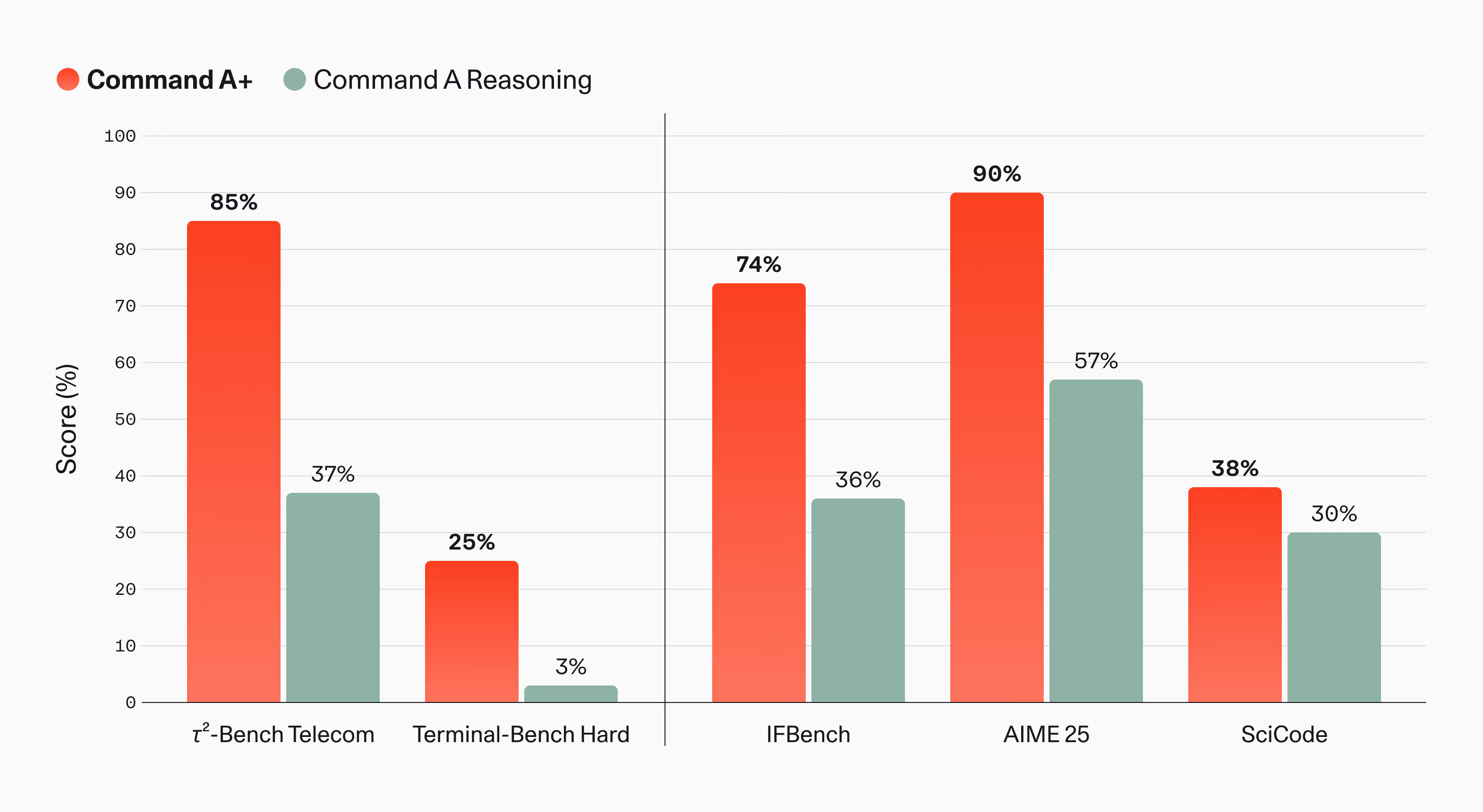
Cohere open-sources Command A+ under Apache 2.0, 218B/25B-active MoE model running on two H100s
Command A+ is a 218B-parameter MoE model with 25B active parameters, a 128K input context, support for 48 languages, and multimodal reasoning, released under Apache 2.0 and runnable on as little as two NVIDIA H100s in W4A4 quantization. Performance improvements over the previous Command A Reasoning are substantial in enterprise-relevant tasks: τ²-Bench Telecom scores improved from 37% to 85%, agentic QA accuracy in North improved by 20%, and spreadsheet analysis quality by 32%. The W4A4 quantization adds a 47% speed increase and a 13% latency reduction relative to higher-precision variants, and the new tokenizer improves efficiency by 20% for Arabic, 16% for Korean, and 18% for Japanese. Open-sourcing a frontier-class enterprise MoE model under Apache 2.0 is a direct move against OpenAI and Anthropic’s closed commercial APIs.
📄 Research spotlights
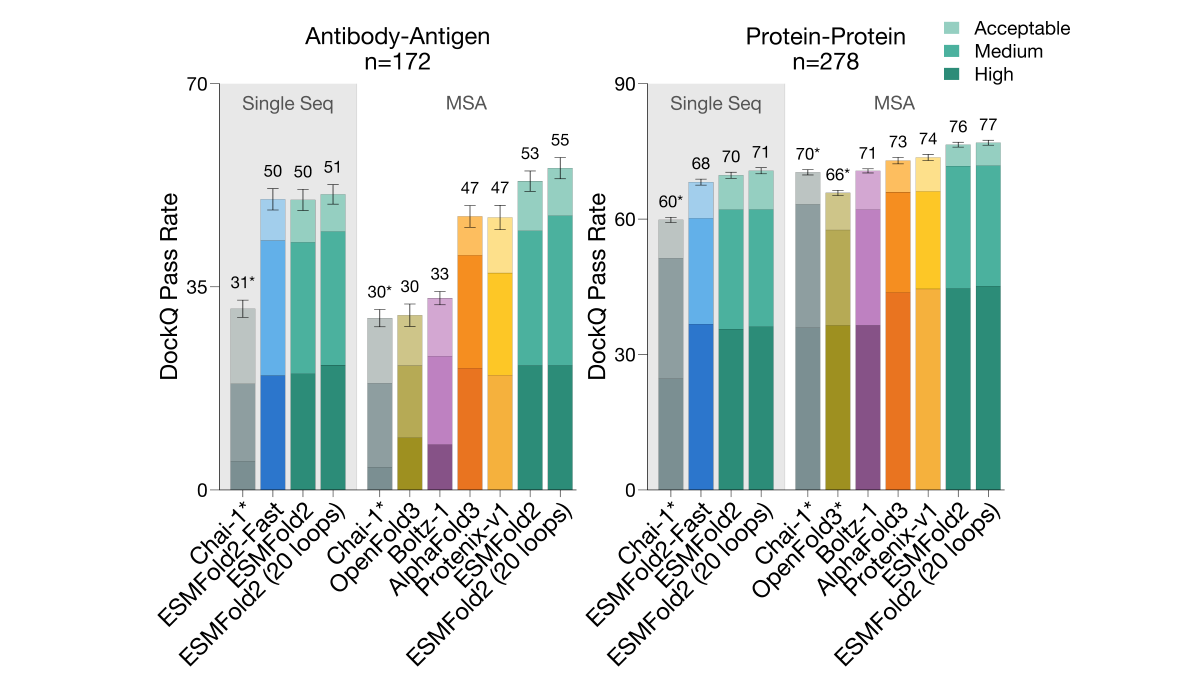
ESMFold2 outperforms all prior models on antibody-antigen complex prediction using language modeling alone
ESMFold2 trained on billions of protein sequences using a pure language modeling objective and then applied mechanistic interpretability techniques originally developed for LLMs to understand what the model learned. On the DockQ benchmark for antibody-antigen complexes (n=172), ESMFold2 in MSA mode scores 55% pass rate, compared to 51% for the next best (ESMFold1 at 20 loops) and just 31% for Chai-1, a margin that matters because antibody-antigen docking is one of the hardest and most clinically relevant structure prediction tasks. The model also releases an atlas of 6.8 billion proteins and 1.1 billion predicted structures as open scientific infrastructure.
Frontier LLMs can write formal code specifications with 77% success
Researchers from CMU and Amazon built Verus-SpecGym, an agentic benchmark of 581 specification-writing tasks derived from Codeforces problems, where models interact with Verus (a formal verifier for Rust) to generate machine-checkable proof specifications from informal problem descriptions. The strongest model, Gemini 3.1 Pro, solves 77.8% of tasks; other frontier models land in the 51–58% range; open-source models top out at 25.5%. The critical finding is not the headline number but the gap structure: models that successfully generate correct code frequently fail to write a correct specification for that same code. A further finding compounds this: LLM-as-a-judge evaluation misses 26% of specification failures that the paper’s executable exec_spec evaluator catches, meaning teams using LLM judges to validate agentic code generation may be systematically blind to a quarter of real errors.
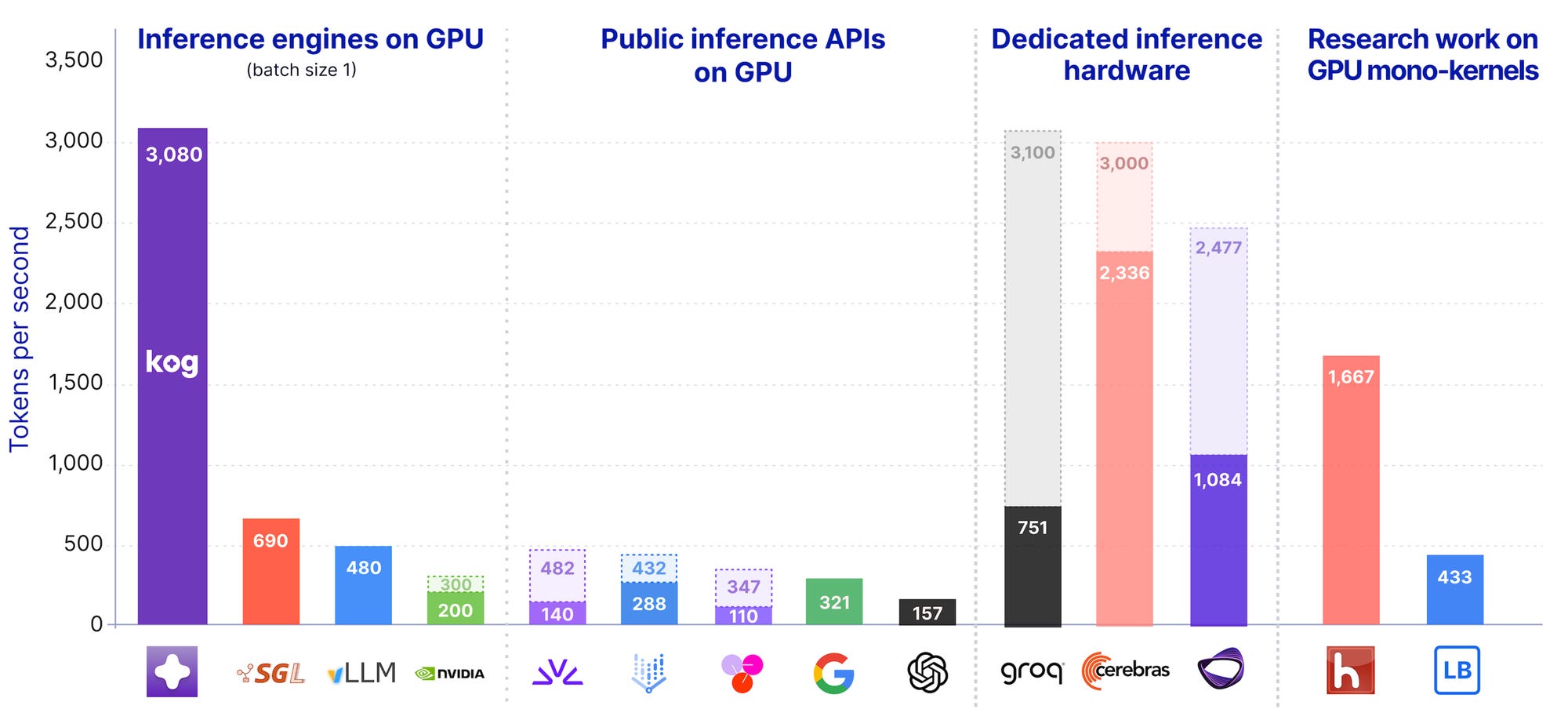
Standard datacenter GPUs can reach 3,000 tokens/second per request
Kog AI’s inference engine (KIE) achieves 3,000 output tokens/s on 8× AMD MI300X GPUs and 2,100 tokens/s on 8× NVIDIA H200 at batch size 1, FP16, without speculative decoding, running a 2B model, with MoE support forthcoming. The technical argument is precise: single-request autoregressive decoding is a memory-bandwidth problem, not a FLOPS problem, because each generated token requires streaming all active weights through HBM at roughly 1 FLOP/byte of arithmetic intensity; the theoretical ceiling on 8× H200 is ~7,700 tokens/s, and on 8× MI300X ~8,400 tokens/s, meaning KIE is reaching roughly 40% of the hardware’s physical limit. The implication for agentic workloads is arithmetic: at 100 tokens/s a 50,000-token agentic workflow takes 8 minutes; at 3,000 tokens/s, it takes under 20 seconds, which is the difference between a tool people tolerate and one that changes how software is written.
💙 Projects we loved over the last two weeks
💙 Gemini Managed Agents give you a sandboxed Linux environment per API call, with code execution, web access, and file I/O baked in.
A single call to client.interactions.create() spins up an isolated environment from a prepared base, mounts skills from a GitHub repo or inline instructions, and forks a clean state for every subsequent use. The agent pattern here is “prepare once, call many times”, the environment scaffold is reusable, but each invocation is stateless.
📊 Dead on Arrival: The AI Dashboard Problem shows that AI-generated dashboards fail in two opposite directions, not one. Darragh Murray ran the same LEGO catalogue dataset through Claude Design three times with increasingly detailed prompts: a naive prompt produced a polished data tour that answered no useful question, a focused brief produced a structured invest/maintain/retire view that recommended retiring themes LEGO had already discontinued years earlier; a heavily guardrailed brief produced something that prosecuted a single conclusion before the analyst had done the analysis to know if that conclusion was right. The failures aren’t model failures; they’re prompt failures at opposite ends: under-specify and you get a mailbox dashboard, over-specify before you’ve interrogated the data and you get a confident position paper.
🔍 Opik is an open-source observability and evaluation platform for LLM applications, covering the full path from prototype to production. It provides tracing across RAG pipelines, code assistants, and multi-step agentic systems, plus evaluation tooling and automatic prompt and tool optimization (all self-hostable under Apache 2.0. Most LLM observability tools are either lightweight loggers or closed-platform products).
💡 Discussions worth reading
The abstraction that matters in agent engineering has moved from the prompt to the harness: Frameworks are being replaced by harnesses, control loops that wrap the model and decide how it decomposes tasks, retries, and manages context. The distinction is simple: a framework is something you assemble, a harness ships already wired and the human provides only the goal. The clearest proof that harnesses now determine product quality came from a Claude Code bug in June. Anthropic had to reset rate limits for all Pro and Max users after some sessions burned through usage far faster than expected. The cause had nothing to do with the model’s reasoning or any feature users deliberately turned on. It was purely orchestration behavior: the way sessions handled parallel subagent calls got out of control inside the loop. Same model, broken harness, wrecked quota.
Test-time compute cannot escape the training manifold: Francois Chaubard makes a pointed argument: if you train on traces of bubble sort and merge sort, TTC will never discover radix sort, because radix sort is outside the human-generated hypothesis space the model was trained on. The modern LLM stack (imitation learning plus a small search budget via TTC leveraging the generator-verifier gap) will always be bounded by the train manifold. Novel programs that are substantially better but orthogonal to human approaches are effectively invisible to it.
Anthropic quietly ended the era of unlimited agentic AI for flat-rate subscribers: Starting June 15, Anthropic split Claude billing into two separate pools: one for first-party tools (claude.ai, the official CLI), another for third-party agent and SDK usage via ACP. Claude Pro and Max subscribers now get a fixed monthly “Agent SDK credit” ($20–$200 depending on plan) for third-party agentic usage, after which usage bills at full API rates. The Zed team’s breakdown is the clearest account of what this means in practice: anyone running agents heavily through tools like Zed was previously getting roughly 15–30x subsidized compute relative to API pricing, and that subsidy is now gone.
Berkeley Law’s total AI ban, including conceptualizing and outlining: The policy prohibits using AI for any aspect of submitted work, including ideation, structuring, and translation, and bars students from uploading course materials to any generative AI system. Economist Alex Tabarrok’s two-word verdict: “Prohibition will fail. This is unworkable.” captures the core problem: a rule this broad is unenforceable, and one that treats looking something up on Perplexity.
China is designing AI token futures, while the US is building GPU compute futures: The Shanghai Futures Exchange is in early-stage design of derivatives contracts tied to AI tokens, the smallest unit of information processed by an AI model as a direct alternative to the compute-layer futures CME and ICE are preparing in the US. The US framing treats AI infrastructure as a hardware problem (GPU hours); the Chinese framing treats it as a services problem (inference tokens as a commodity like bandwidth or electricity).
💰 Money moving in AI and data
$65 billion Series H at ~$965 billion valuation: Anthropic raised $65 billion led by Altimeter Capital, Dragoneer, Greenoaks, and Sequoia, putting it within striking distance of a trillion-dollar valuation, filed a confidential S-1, and locked in $1.25B/month compute contracts with SpaceX’s Colossus 1. The combination turns what looked like a capital-intensive AI lab into a vertically integrated infrastructure play ahead of a public offering.
$60 billion all-stock acquisition: SpaceX bought AI coding startup Cursor for $60B days after its own IPO, paying in stock at just 3.4% dilution thanks to its surging share price. Cursor brings $2.6B in annualized revenue and fills the coding gap left by SpaceXAI after absorbing xAI, while investors like Chamath Palihapitiya read the deal as a bet on owning the “control plane”.
$1.25B/month (Anthropic) + $920M/month (Google) compute contracts: SpaceX walked into its IPO with $2.17 billion in monthly committed revenue from just two AI clients, Anthropic renting all available capacity at Colossus 1, Google paying for ~110,000 Nvidia GPUs at a separate facility. Transforming its xAI data center division from a money-losing side project (11% utilization before the Anthropic deal) into the most consequential AI infrastructure contracting story of the year.
$1 billion at $25 billion pre-money valuation: Cognition, maker of autonomous coding agent Devin, raised from Lux Capital and General Catalyst at a valuation that more than doubled in eight months, backed by $492M in annualized revenue run-rate and 50% month-over-month enterprise growth.
$50+ billion fundraise in talks: Switch, the data center operator taken private by DigitalBridge in 2022 for $11 billion, is in talks with Brookfield and KKR at a valuation that would represent a 4x+ step-up in under four years.
$6 billion commitment: Snowflake expanded its AWS partnership with a $6 billion spend commitment to accelerate enterprise agentic AI, signaling that cloud hyperscalers and data platforms are now racing to lock in each other’s infrastructure budgets.
$400 million Series D at a $5.4 billion valuation: Suno, the AI music generation platform, raised from Bond Capital and others at more than double its $2.45B valuation from seven months ago, despite active copyright lawsuits from UMG and Sony still in court.
$135 million Series B at $570 million valuation: XCENA, the South Korean chip startup whose MX1 chip places compute directly inside DRAM to eliminate the CPU/GPU round-trips that bottleneck inference, raised from Atinum and IMM Investment; with Samsung, SK Hynix, and Micron all crossing trillion-dollar valuations this month, the memory layer is being repriced as core AI infrastructure, not commodity supply.
$75 million acquisition: Asana acquired YC-backed StackAI for $75M, a no-code platform that deploys AI agents across Salesforce, Oracle, AWS, and Slack. The deal, announced alongside earnings, is Asana’s explicit entry into the race to own the orchestration layer between human workers and AI agents before Microsoft Copilot Studio and Salesforce Agentforce lock it in.
Acquisition (undisclosed): OpenAI acquired Ona (formerly Gitpod), a German startup providing secure cloud sandboxes for persistent AI agents, to let Codex run multi-day tasks unattended after a developer closes their laptop.
$50 million seed: Radical Numerics, founded by the team that built Evo and Evo 2 (the first models capable of generating DNA at genomic scale), launched from stealth with backing from Emergence Capital and Patrick Collison, building multimodal models that reason across DNA, RNA, and proteins simultaneously.